
How to Create No-Code AI Builder Making $1,941/Month
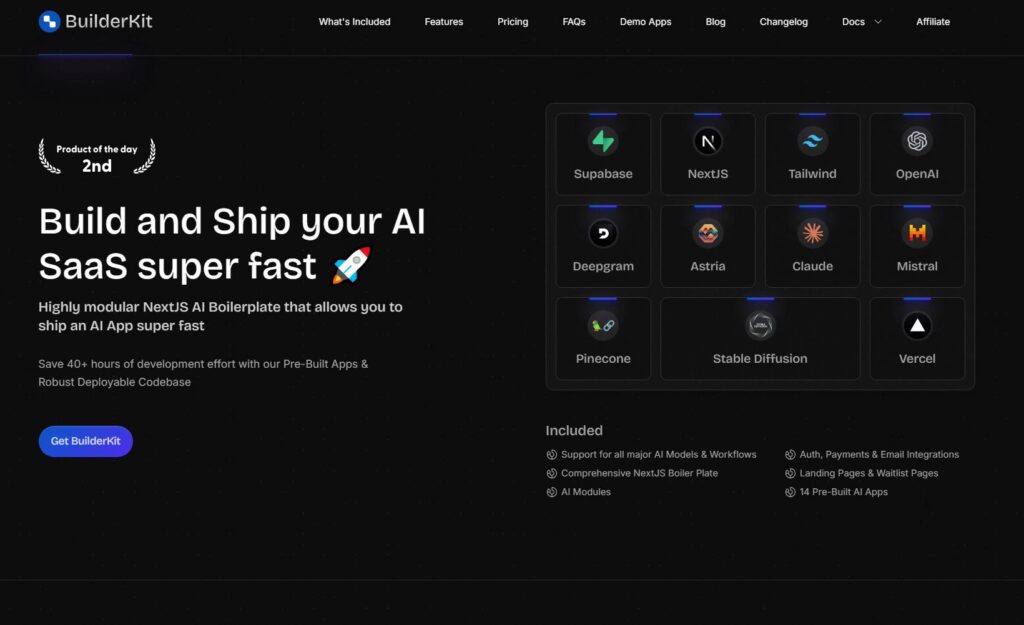
What if you could sell shovels during a gold rush?
That’s exactly what BuilderKit figured out.
While everyone’s scrambling to build AI-powered apps, BuilderKit makes $1,941 in monthly profit selling the tools that let anyone create AI products—without writing a single line of code.
No venture funding. No massive team. Just a smart platform serving creators who want to launch AI tools but don’t have engineering degrees.
Here’s what makes this brilliant…
The AI boom created insane demand for custom AI applications. Every entrepreneur wants to launch an AI tool. Every small business wants AI-powered features. Every agency wants to offer AI solutions to clients.
But there’s a massive problem—building AI apps from scratch requires serious technical skills most people don’t have.
BuilderKit bridges that gap by providing pre-built components and templates that let anyone assemble AI tools like Legos. No coding required. Just drag, drop, customize, and launch.
And while the AI app market gets crowded, the market for tools that help people build AI apps? Still wide open.
Let’s break down exactly how BuilderKit built their business and how you can replicate this “sell shovels” strategy.
Ad 🎯 After studying 400+ business models, here’s what actually works for beginners…
Most “make money online” advice is garbage. Complex affiliate schemes. Dropshipping nightmares. Social media “influencing.”
We found something better: lead-generation funnels for manufacturers. Simple. Profitable. Fast results.
Our Max Incubator Phase 1 students are proof—they’re going from zero to their first $1,000 in 90 days with this exact model.
→ See the business idea that’s working for beginners this year
What BuilderKit Actually Does (And Why Creators Love It)
BuilderKit is a no-code platform specifically designed for building and launching AI-powered tools.
Think of it as a construction kit where all the hard technical work is already done—you just assemble the pieces into your specific application.
The platform provides pre-built AI components like text generation modules, image processing tools, chat interfaces, data extraction features, and content analysis systems. Users combine these components, customize the interface, add their branding, and launch functional AI tools.
No dealing with APIs. No configuring cloud infrastructure. No debugging complex code.
Here’s who this serves…
Solopreneurs who want to launch AI products without technical co-founders. Small agencies offering AI solutions to clients without hiring developers. Entrepreneurs testing AI product ideas before investing in custom development. And creators monetizing AI tools without extensive programming knowledge.
The strategic genius is this—BuilderKit doesn’t compete with the thousands of AI apps being launched. Instead, they provide the infrastructure those apps are built on.
When you sell shovels during a gold rush, you profit whether anyone actually finds gold.
The Revenue Model: Tiered SaaS With Upsell Opportunities
Let’s break down how BuilderKit generates $1,941 in monthly profit.
They use tiered subscription pricing that scales with customer needs and sophistication.
Starter Plan: $19/Month
The entry-level plan targets beginners and indie creators testing ideas.
At $19 monthly, this plan provides access to basic AI components, standard templates, limited deployment options, and community support. It’s priced low enough to minimize purchase hesitation while still generating meaningful revenue at scale.
This tier serves as the customer acquisition engine—getting users into the platform and hooked on the value before upgrading them to higher plans.
Pro Plan: $79/Month
The mid-tier plan targets serious creators and small agencies building multiple AI tools.
For $79 monthly, users get access to advanced AI components, custom branding options, unlimited deployments, priority support, and white-label capabilities.
This is likely where BuilderKit generates most revenue—customers who’ve proven the platform works and now need more sophisticated features.
Agency Plan: $149/Month
The premium tier targets agencies and consultants building AI tools for multiple clients.
At $149 monthly, users get everything in Pro plus team collaboration features, client management tools, advanced customization options, and dedicated support.
These high-value customers generate substantial revenue while typically requiring less hand-holding since they’re technically sophisticated.
According to Paddle’s SaaS pricing research, tiered pricing structures typically convert 2-5% of free trial users to paid plans, with 30-40% eventually upgrading to higher tiers as usage grows.
Affiliate Program Revenue
Beyond subscriptions, BuilderKit offers an affiliate program where users earn commissions for referrals.
This creates a viral growth loop—satisfied customers become promoters, bringing in new users while generating additional income for themselves.
Custom Services Upsells
For customers wanting help implementing specific features, BuilderKit offers custom development services.
These high-margin services generate significant additional revenue beyond base subscriptions while providing personalized solutions for premium customers.
What BuilderKit Does Exceptionally Well
So how does a no-code AI platform build nearly $2,000 in monthly profit?
Through strategic decisions that position them perfectly for the AI boom.
Laser-Focused Niche Positioning
BuilderKit doesn’t try to be a general no-code platform competing with Bubble or Webflow.
They focus exclusively on AI tool creation, which allows them to provide specialized components and templates that generic platforms can’t match. This specificity makes them the obvious choice for anyone wanting to build AI apps.
Trying to serve all no-code use cases dilutes your value proposition. Specializing in AI tools creates clear differentiation and attracts exactly the right customers.
Excellent Landing Page Design
Visit BuilderKit’s website and you immediately understand what they offer and who it’s for.
The landing page features clean, modern design that conveys professionalism, animated demonstrations showing the platform in action, prominent CTAs like “Start Building” driving action, and clear benefit-focused copy rather than feature lists.
This professional presentation builds trust instantly—critical for a platform where people are investing time learning your tools.
Real Use Case Demonstrations
BuilderKit showcases actual tools built on their platform with links to live demos.
These include resume generators, idea validators, content analyzers, and other functional AI apps. Seeing real examples accomplishes several goals—it proves the platform actually works, it sparks ideas for potential users, and it provides social proof through concrete results.
Abstract promises about “building anything” are far less convincing than specific working examples.
SEO-Optimized Example Pages
BuilderKit creates dedicated pages for different AI tool categories like “AI Resume Builder Examples” or “AI Content Generator Templates.”
These pages target long-tail search terms from people researching specific AI applications. They serve dual purposes—attracting targeted organic traffic while showcasing platform capabilities.
According to Ahrefs’ keyword research, long-tail searches often convert 2-3x better than generic terms while being significantly easier to rank for.
Public Roadmap Building Trust
BuilderKit maintains a public roadmap showing planned features and updates.
This transparency creates several benefits—it builds trust by showing active development, it involves users in product evolution, it manages expectations about upcoming features, and it demonstrates long-term commitment to the platform.
For a tool where users invest time learning, knowing the platform will continue improving provides crucial reassurance.
Critical Growth Opportunities Being Missed
Despite solid monthly profit, BuilderKit is missing several opportunities that could substantially increase revenue.
Implement Email Capture System
Currently, BuilderKit doesn’t appear to offer any lead magnets for capturing emails before visitors are ready to subscribe.
They should offer a free AI tool template in exchange for email addresses, provide a short email course on building and monetizing AI tools, send automated sequences educating about different platform capabilities, and nurture leads who aren’t ready to purchase immediately.
Many visitors need to see value multiple times before subscribing. An email list lets you build relationships over time rather than losing visitors forever after one visit.
Create Educational Blog Content
BuilderKit has minimal blog content—missing massive SEO opportunity.
They should publish comprehensive guides like “How to Build and Sell AI Tools in 2025,” “Top No-Code AI Tools for Entrepreneurs,” “Building Your First AI SaaS Product,” and “Monetizing AI Applications: Complete Guide.”
This content would attract organic traffic, establish thought leadership, educate potential customers, and create natural opportunities to introduce BuilderKit as the solution.
Educational content marketing typically reduces customer acquisition costs by 50-70% compared to paid advertising alone.
Add Social Proof Above the Fold
BuilderKit’s homepage doesn’t immediately show testimonials, reviews, or trust signals.
They should prominently feature customer quotes describing specific results, logos of successful tools built on the platform, user statistics like “2,000+ AI tools created,” and trust badges or awards if applicable.
For a platform requiring time investment to learn, social proof dramatically reduces purchase hesitation by proving others have succeeded.
Create Video Demonstrations
Many potential users want to see the platform in action before subscribing but hesitate to sign up without understanding it.
BuilderKit should produce 2-3 minute walkthrough videos showing the build process, case study videos featuring successful users, tutorial series covering different use cases, and live building sessions demonstrating platform capabilities.
Video content serves multiple purposes—it educates potential customers, reduces friction in the evaluation process, improves conversion rates, and provides shareable content for social media.
Expand Template Library Aggressively
While BuilderKit offers some templates, dramatically expanding this library would add massive perceived value.
They should create industry-specific templates for marketing, HR, healthcare, education, and finance. Build ready-to-launch templates for common AI applications. Develop niche templates solving specific problems. And package premium template bundles as upsell opportunities.
A comprehensive template library shortens time-to-value for new users while creating additional monetization opportunities through premium template sales.
Ad 🎯 Ready to put these strategies into action?
Theory is great, but execution is what drives growth. That’s where Max Business School™ comes in.
Inside, you’ll find step-by-step digital marketing courses (SEO, ads, email, social, content, and more) — taught by professionals, designed for beginners and business owners alike.
And the best part? It’s 100% free, online, and flexible.
→ Join Max Business School Today — Free
Your Blueprint for Building a No-Code AI Platform
Want to build your own no-code platform serving the AI boom?
Here’s your step-by-step blueprint based on BuilderKit’s success.
Step 1: Choose Your Specific Niche
Don’t try to build a general no-code platform—find your focused angle within the AI space.
Consider specializing in AI chatbot builders, AI content generation tools, AI image processing platforms, AI data analysis applications, or AI voice interaction systems.
The narrower your focus, the better you can optimize for that specific use case and the clearer your value proposition becomes.
Step 2: Develop Core Component Library
Your platform needs pre-built components that users can assemble into applications.
Start with 5-10 essential components that cover the most common use cases. Ensure each component works reliably and consistently. Create clear documentation for how each component functions. And build simple interfaces for customizing component behavior.
Quality beats quantity initially—it’s better to have 10 components that work perfectly than 50 that are buggy or confusing.
Step 3: Build Using No-Code Tools Initially
You can actually build a no-code platform using no-code tools—at least for your MVP.
Use Bubble or similar platforms for your interface. Integrate AI APIs from OpenAI, Anthropic, or specialized services. Implement Stripe for subscription billing. And create a simple user dashboard for managing projects.
Budget $5,000-10,000 for initial no-code development, or plan several months of focused effort if building yourself.
Step 4: Create Compelling Templates
Templates are your primary education and marketing tool.
Build 5-10 fully functional example applications users can clone and customize. Create templates solving real problems in specific industries. Document each template with use cases and customization guides. And showcase templates prominently on your website.
Templates demonstrate what’s possible while dramatically reducing time-to-value for new users.
Step 5: Implement Tiered Pricing
Structure your pricing to capture different customer segments.
Offer a starter plan at $15-25/month for individuals. Create a pro plan at $60-100/month for serious creators. Add an agency plan at $150-200/month for teams. And clearly differentiate what each tier includes.
Tiered pricing maximizes revenue by letting customers self-select based on their needs and budgets.
Step 6: Focus on User Success
For platforms with learning curves, customer success determines retention.
Create comprehensive documentation and tutorials. Offer responsive support during onboarding. Build a community where users help each other. And proactively reach out to users who seem stuck.
Happy, successful users don’t churn—they upgrade and refer others.
Step 7: Build SEO From Day One
Educational content will become your most valuable traffic source.
Research keywords your target users search for. Create use case pages for different applications. Publish tutorials and guides regularly. And build backlinks through partnerships with AI and no-code communities.
SEO compounds over time to become incredibly valuable for SaaS businesses.
Step 8: Launch Affiliate Program Early
Turn your users into promoters who bring in new customers.
Offer 30-40% recurring commissions. Provide affiliates with promotional materials. Create higher commission tiers for top performers. And feature successful affiliates in case studies.
Affiliate programs create viral growth loops where satisfied customers actively promote your platform.
Key Takeaways: Building Your No-Code AI Empire
Let’s distill the critical lessons from BuilderKit’s success.
Sell shovels during gold rushes. While everyone builds AI apps, BuilderKit profits by providing the tools that enable that building. Look for infrastructure opportunities in trending spaces rather than competing directly.
Niche focus beats general platforms. Specializing in AI tools creates clear differentiation versus general no-code platforms. Find your specific angle rather than trying to serve all use cases.
Templates sell the vision. Real examples showing what’s possible convince skeptical users far better than feature lists. Invest heavily in compelling templates that demonstrate platform capabilities.
Tiered pricing maximizes revenue. Different customers have different needs and budgets. Multiple pricing tiers capture the full spectrum from beginners to agencies.
User success determines everything. For platforms with learning curves, helping users succeed quickly is the highest-leverage activity for reducing churn and generating referrals.
Affiliate programs create viral loops. Satisfied users become promoters when properly incentivized, creating self-sustaining growth that reduces acquisition costs over time.
Educational content drives sustainable growth. Teaching people how to succeed with your platform attracts ideal customers while building authority and trust before asking for subscriptions.
The no-code market is projected to reach $45 billion by 2025, according to Gartner, with AI-specific no-code tools representing one of the fastest-growing segments.
Your Turn to Build
Here’s the truth about no-code platforms…
The AI boom is real and lasting. Demand for AI tools will only increase. But most people can’t build AI applications from scratch and don’t want to learn complex programming.
BuilderKit proves you can build a profitable business providing the infrastructure that bridges this gap—helping non-technical creators launch AI tools without code.
The same playbook works for other trending technologies waiting for accessible building tools. Voice interfaces, AR experiences, blockchain apps, IoT devices—all have massive gaps between demand and accessibility.
The question isn’t whether no-code platforms can be profitable. BuilderKit and dozens of similar tools prove they absolutely can be.
The question is: which emerging technology will you make accessible to non-technical creators?
Successful no-code platforms like Bubble, Webflow, and Zapier prove that empowering non-technical users to build sophisticated applications creates substantial businesses serving massive markets.
Your move.