
How to Start Contemporary Furniture Store Making $30M/Year
Ever walked into a furniture store that felt like stepping into a time machine—but instead of feeling dated, it felt impossibly elegant?
That’s the magic of heritage done right.
While most furniture retailers chase the latest trends or race to the bottom on price, one British institution has been quietly printing money for over two centuries by doing something far more interesting.
They blend museum-worthy craftsmanship with sleek modern design.
And it’s working. To the tune of $30 million per year.
Meet Heal’s, a contemporary furniture brand that’s cracked the code on selling high-end home furnishings online. No gimmicks, no viral TikTok dances, just beautiful products presented with the kind of authority that only comes from knowing what you’re doing.
Here’s what makes this case study fascinating…
Most entrepreneurs think you need to be the cheapest or the trendiest to win in e-commerce. Heal’s proves you can build a thriving business by being the most refined, the most knowledgeable, and the most respected in your niche.
They’re not trying to be IKEA. They’re not trying to be Wayfair. They’re being Heal’s—and their customers are willing to pay premium prices for that distinction.
So how does a centuries-old furniture brand generate eight figures annually in today’s ruthlessly competitive online marketplace?
Let’s pull back the curtain.
Ad 🎯 After studying 400+ business models, here’s what actually works for beginners…
Most “make money online” advice is garbage. Complex affiliate schemes. Dropshipping nightmares. Social media “influencing.”
We found something better: lead-generation funnels for manufacturers. Simple. Profitable. Fast results.
Our Max Incubator Phase 1 students are proof—they’re going from zero to their first $1,000 in 90 days with this exact model.
→ See the business idea that’s working for beginners this year
What Heal’s Actually Does (And Why Heritage Matters)
Heal’s isn’t your average furniture store.
This isn’t a place where you’ll find flat-pack nightmares or mass-produced mediocrity. Instead, Heal’s curates a carefully selected collection of contemporary furniture and homeware that bridges the gap between timeless elegance and modern functionality.
Think of them as the gallery of the furniture world—every piece tells a story, every collection reflects thoughtful curation, and every product carries the weight of centuries of design expertise.
But here’s where it gets interesting…
While their competitors scramble to stock whatever’s trending on Instagram this week, Heal’s leans into their heritage. They showcase the history behind their pieces, highlight the craftsmanship that goes into each item, and position themselves as custodians of quality rather than just sellers of stuff.
This creates something invaluable in e-commerce: trust.
When someone’s about to drop several thousand dollars on a sofa they’ve never sat on, trust matters more than free shipping. And Heal’s has spent two centuries building that trust—now they’re leveraging it online to spectacular effect.
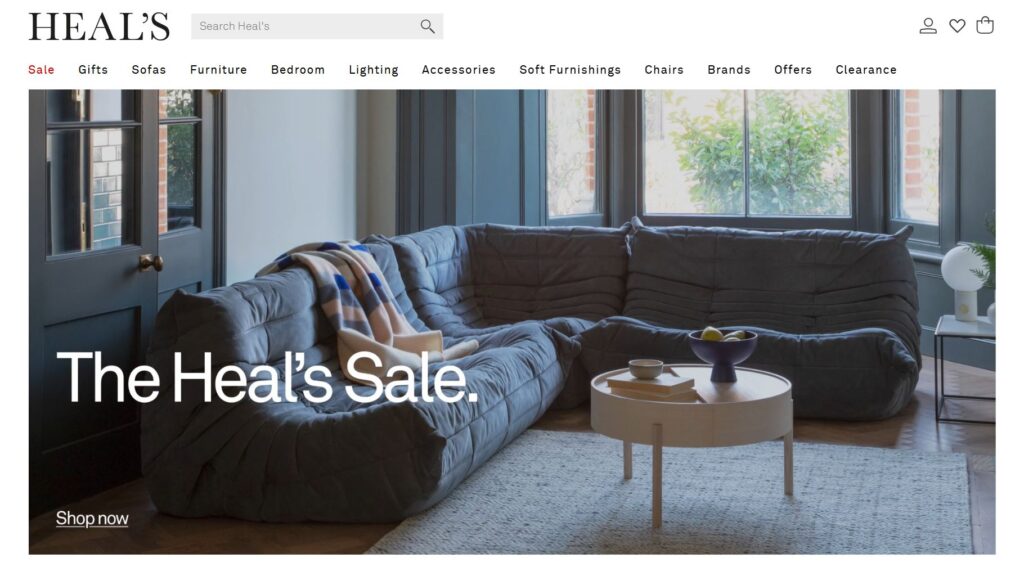
Their website reflects this positioning perfectly. Rich photography that makes you feel like you’re browsing a design magazine, detailed product descriptions that read like love letters to craftsmanship, and a layout that whispers “luxury” without screaming “expensive.”
It’s furniture shopping elevated to an experience.
The Revenue Model: How Premium Positioning Prints Money
Let’s talk about how Heal’s turns beautiful furniture into beautiful profit margins.
The revenue model here is refreshingly straightforward, but the execution is where the magic happens. Understanding this approach is critical if you want to build your own premium e-commerce brand.
Revenue Stream #1: Direct Product Sales
This is the foundation of the business—selling curated contemporary furniture and homeware directly to customers through their website.
But here’s what separates Heal’s from every other furniture retailer cluttering up Google Shopping ads…
They don’t compete on price. They compete on curation, quality, and the intangible feeling of owning something special. Their customers aren’t looking for the cheapest sofa—they’re looking for the right sofa from a brand they trust.
This positioning allows them to maintain healthy margins while their competitors race to the bottom. According to research from McKinsey on luxury retail, premium brands that successfully communicate their heritage and craftsmanship can command price premiums of 30-50% compared to mass-market alternatives.
Heal’s captures every penny of that premium.
Revenue Stream #2: Interior Design Consultations
Here’s where the model gets even smarter.
Heal’s doesn’t just sell furniture—they sell expertise. Their interior design consultation services transform them from a retailer into a trusted advisor, guiding customers through the often-overwhelming process of furnishing their spaces.
Think about the psychology here for a second…
Someone books a consultation because they’re uncertain about their choices. They spend an hour with a Heal’s designer who shows them how different pieces work together, explains the thought process behind room layouts, and ultimately recommends specific products.
What’s the likelihood that customer buys from Heal’s after that experience?
Nearly guaranteed. And they’ll probably spend more than they initially planned because they now understand the value of what they’re buying.
The consultation fee itself might be modest—maybe $150-300 depending on the service level—but it’s not really about the consultation revenue. It’s about dramatically increasing average order value and conversion rates.
Revenue Stream #3: Bespoke Furniture Services
Want a sofa in a specific fabric that’s not listed online? Need a dining table sized exactly for your space? Heal’s can make that happen.
Their bespoke furniture services cater to customers with specific needs and even deeper pockets. This isn’t mass customization like “pick your fabric from these five options”—this is genuine made-to-order furniture crafted to exact specifications.
The margins on bespoke work are exceptional because you’re selling a one-of-a-kind product with no direct competition. There’s no price comparison website for custom furniture made to your grandmother’s measurements.
Plus, bespoke clients tend to become repeat customers and enthusiastic brand ambassadors. When you’ve invested in having something custom-made, you’ve psychologically invested in the brand relationship.
Research from Furniture Today indicates that retailers offering customization services see 40% higher customer lifetime value compared to those selling only standard configurations.
Content Strategy: Selling Stories, Not Just Sofas
Want to know the real secret behind Heal’s success?
They understand that people don’t buy furniture—they buy the feeling of walking into their beautifully furnished home and thinking “yes, this is exactly who I am.”
Heritage Storytelling: The Emotional Foundation
Every product page on Heal’s website does something brilliant—it tells you why this piece matters.
They showcase the history behind their designs, highlight the artisans who craft each piece, and explain the design philosophy that informs their aesthetic. This isn’t marketing fluff—this is the foundation of their value proposition.
When you’re reading about a chair designed by someone whose name appears in design history books, suddenly that price tag makes perfect sense. You’re not buying a chair—you’re buying a piece of design heritage for your home.
This approach to content transforms transactions into investments and browsers into believers.
Visual Excellence: Photography That Sells
Heal’s doesn’t show you a sofa on a white background and call it a day.
Every product is photographed in beautifully styled room settings that make you envision how it would look in your own space. Multiple angles, close-ups of fabric textures, lifestyle shots showing the piece in context—nothing is left to imagination.
Why does this matter so much?
Because the biggest barrier to buying furniture online is uncertainty. Customers can’t touch the fabric, sit on the sofa, or see how the color looks in their lighting. Exceptional photography bridges that gap by providing as much sensory information as possible through visual means alone.
According to studies from BigCommerce on product photography, high-quality lifestyle images increase conversion rates by up to 30% compared to standard product shots.
Educational Content: Building Authority
Heal’s regularly publishes content about design trends, decorating tips, and furniture care guides.
This accomplishes several things simultaneously. It attracts organic search traffic from people researching furniture purchases. It positions Heal’s as design experts rather than just retailers. It provides value to customers beyond the transaction. And it keeps the brand top-of-mind during the long consideration period typical of furniture purchases.
Someone researching “how to choose the right sofa for a small living room” might land on a Heal’s guide—and three months later when they’re ready to buy, guess which brand they remember?
SEO and Digital Presence: How Heritage Brands Win Online
Here’s where most traditional retailers stumble into the digital age like confused tourists…
They try to apply brick-and-mortar thinking to online commerce and wonder why nobody’s buying.
Heal’s understands something fundamental: online retail requires a completely different playbook.
Technical Excellence: The Foundation
Heal’s website loads fast—critical when you’re serving high-resolution product photography to mobile users on spotty connections.
The site architecture is logical and intuitive, making it easy for both customers and search engines to navigate. Product pages are optimized with descriptive titles, detailed specifications, and structured data that helps search engines understand exactly what’s being sold.
Mobile optimization is flawless, because anyone browsing furniture at 11 PM from their couch better have a seamless experience. All the boring technical SEO fundamentals—XML sitemaps, clean URL structure, proper redirects—are handled correctly.
This might sound basic, but most e-commerce sites get these fundamentals wrong. Heal’s gets them right, which means search engines trust and reward their site.
Category and Product SEO: Capturing Purchase Intent
Heal’s targets the search terms that matter—specific product types and design styles that indicate purchase intent.
Instead of chasing impossible head terms like “furniture” (dominated by giants with unlimited budgets), they focus on specific, valuable queries like “mid-century modern dining table,” “contemporary velvet sofa,” or “designer coffee table UK.”
These searches represent people who know what they want and are ready to buy. Lower volume, but infinitely more valuable traffic.
Their product descriptions are detailed enough to rank for long-tail variations while remaining readable and persuasive. They include measurements, materials, care instructions, and design details—information that both customers and search engines value.
Strategic Partnerships: The Hidden SEO Goldmine
Heal’s partners with architects and interior designers who regularly specify their furniture for client projects.
Here’s the genius of this approach…
Every time a design professional features Heal’s products in a case study, blog post, or portfolio piece, that’s a high-quality backlink from a relevant, authoritative source. These are exactly the kinds of links that move the needle in search rankings.
Plus, these partnerships generate qualified referral traffic from people who’ve already been convinced by a design professional that Heal’s is the right choice.
According to Ahrefs research on backlinks, links from relevant industry sites carry significantly more SEO weight than random directory submissions or link farms—making strategic partnerships one of the most effective SEO tactics available.
The Customer Experience: Where Premium Justifies Price
Anyone can slap premium prices on furniture and call themselves luxury.
The hard part? Actually delivering an experience that justifies those prices. This is where Heal’s separates itself from pretenders.
Detailed Product Information
Every product page answers every possible question before you think to ask it.
Dimensions from every angle. Material specifications. Assembly requirements. Care instructions. Weight capacity. Available customization options. Delivery timelines. Everything.
Why does this matter? Because every unanswered question is a potential objection that prevents a sale. Heal’s eliminates those objections before they form.
Professional Design Consultation
The consultation services aren’t just an upsell—they’re a genuine value-add that helps customers make better decisions.
This transforms Heal’s from a vendor into a partner in creating your ideal living space. That relationship is worth far more than any single transaction.
Delivery and Installation
Premium furniture deserves premium delivery service.
Heal’s coordinates white-glove delivery and professional installation, ensuring your expensive new sofa arrives in perfect condition and is set up exactly right. No damaged goods, no “oops, we left you with a flat-pack puzzle”—just furniture that arrives ready to enjoy.
This removes the anxiety from large furniture purchases and eliminates one of the major objections to buying furniture online.
What Heal’s Could Improve (The Massive Opportunities)
Despite generating $30 million annually, Heal’s is leaving money on the table.
Here are the massive growth opportunities they’re not fully exploiting yet.
Personalized Online Design Consultations
Imagine booking a video consultation with a Heal’s designer from anywhere in the world.
You show them your space via smartphone, they recommend pieces and create a virtual mood board, and you get personalized design guidance without needing to visit a physical showroom. This would expand their consultation services to a global audience while maintaining that premium, personalized experience.
The technology exists—tools like Zoom and digital mood boarding platforms make this trivially easy. The question is implementation and marketing.
Virtual Reality Showroom Experience
Here’s a game-changer that’s criminally underutilized in furniture retail…
Virtual reality showrooms would let customers explore fully furnished rooms, examine products from every angle, and visualize pieces in realistic settings—all from their browser. No plugins, no apps, just immersive product experiences that bridge the gap between online and in-person shopping.
Companies like Matterport have made this technology accessible even for smaller retailers. For a brand at Heal’s scale, implementing VR showrooms could be transformative.
Customers could virtually walk through curated room settings, see how different pieces complement each other, and make more confident purchase decisions. The impact on conversion rates and average order value could be substantial.
Sustainable and Upcycled Furniture Line
There’s a growing market of environmentally conscious consumers who want beautiful furniture without the environmental guilt.
Heal’s could launch a curated collection of upcycled, refurbished, and sustainably produced furniture pieces. This would tap into the sustainability trend while differentiating them from competitors and potentially attracting a younger, values-driven customer segment.
According to Nielsen research on sustainable shopping, 73% of consumers say they would definitely or probably change their consumption habits to reduce environmental impact—and they’re willing to pay premium prices for sustainable options.
Heal’s already has the premium positioning and design credibility. Adding sustainability to that mix could unlock an entirely new customer segment.
Expanded Content Marketing
Heal’s content game is solid, but it could be exceptional.
Regular video content showcasing design transformations, behind-the-scenes looks at furniture craftsmanship, or interviews with designers would build deeper audience engagement. A podcast about design trends and home aesthetics could position Heal’s as thought leaders in the space.
More aggressive content distribution through YouTube, Pinterest, and Instagram would capture audience attention earlier in their purchase journey—building brand awareness and preference long before someone’s ready to buy.
Ad 🎯 Ready to put these strategies into action?
Theory is great, but execution is what drives growth. That’s where Max Business School™ comes in.
Inside, you’ll find step-by-step digital marketing courses (SEO, ads, email, social, content, and more) — taught by professionals, designed for beginners and business owners alike.
And the best part? It’s 100% free, online, and flexible.
→ Join Max Business School Today — Free
Your Blueprint for Building a Premium Furniture Brand
Ready to build your own contemporary furniture empire?
Here’s your step-by-step blueprint based on what Heal’s does brilliantly (and where they could improve).
Step 1: Define Your Niche and Positioning
Don’t try to be everything to everyone—that’s how you become nothing to no one.
Choose a specific aesthetic (mid-century modern, Scandinavian minimalism, industrial chic, artisan handcrafted), target a specific customer segment (young professionals furnishing first homes, empty nesters downsizing, luxury apartment dwellers), and identify your unique value proposition (heritage craftsmanship, sustainable materials, innovative design, exceptional customization).
Heal’s owns the “contemporary furniture with heritage craftsmanship” niche. What niche will you own?
Step 2: Source or Create Your Products
You have several options for getting started without manufacturing furniture yourself.
Curate existing brands by partnering with furniture makers and designers to sell their pieces through your platform. Start with private label pieces by working with manufacturers to create exclusive designs under your brand. Consider dropshipping arrangements with reputable furniture suppliers to test products before committing to inventory.
As you grow, you can invest in custom designs and potentially your own manufacturing relationships.
Step 3: Build Your E-Commerce Foundation
Your website is your showroom, so treat it accordingly.
Choose the right platform—Shopify, WooCommerce, or BigCommerce all work well for furniture retail. Invest heavily in product photography because people buy with their eyes first. Implement robust filtering and search to help customers find exactly what they’re looking for. Ensure your site loads fast and looks beautiful on mobile devices.
Don’t skimp on this step. A mediocre website kills premium positioning faster than anything else.
Step 4: Master Content and SEO
Create comprehensive product pages with detailed descriptions, measurements, materials, and multiple high-quality images.
Write educational content about furniture selection, design trends, and care guides. Build relationships with interior designers, architects, and design bloggers for partnerships and backlinks. Optimize for specific, purchase-intent keywords rather than generic high-volume terms.
Remember, you’re not competing with Wayfair’s marketing budget. You’re targeting specific customers who value what makes you different.
Step 5: Provide Exceptional Customer Experience
Premium pricing requires premium service.
Offer design consultation services—even if you start with just email or phone consultations. Provide detailed product information that answers every possible question. Arrange reliable delivery and installation to eliminate purchase anxiety. Create a generous return policy to reduce buying risk.
Every interaction should reinforce that customers made the right choice choosing your brand.
Step 6: Build Strategic Partnerships
Connect with interior designers, architects, and home stagers who can specify your furniture for their clients.
Partner with design schools or programs for brand awareness among emerging designers. Collaborate with complementary brands for co-marketing opportunities. Participate in design exhibitions or trade shows to build credibility.
These partnerships generate high-quality referrals, valuable backlinks, and brand credibility that paid advertising can’t buy.
Step 7: Leverage Visual Platforms
Furniture is inherently visual, so excel where visuals matter most.
Build a stunning Instagram presence showcasing your products in beautiful room settings. Use Pinterest to drive traffic with design inspiration and styled room ideas. Consider TikTok or YouTube for behind-the-scenes content about design and craftsmanship. Encourage customers to share photos of your furniture in their homes.
Visual social proof is incredibly powerful for furniture sales.
Key Takeaways: Building Your Furniture Empire
Let’s distill everything down to the essentials.
If you’re serious about building a contemporary furniture brand, these are the principles you can’t afford to ignore.
Premium positioning is about trust, not just price. Heal’s doesn’t just charge premium prices—they’ve earned the right to charge them through heritage, quality, and expertise. Build the credibility that justifies your pricing before expecting customers to pay it.
Content sells as much as products do. Every piece of content—product descriptions, photography, design guides, brand storytelling—either moves customers closer to purchase or pushes them away. Invest in making every customer touchpoint exceptional.
Experience justifies expense. Design consultations, white-glove delivery, bespoke customization—these aren’t optional extras, they’re the reason customers choose premium brands over cheap alternatives. Make the experience memorable at every stage.
Strategic partnerships amplify reach. Relationships with interior designers, architects, and design professionals provide referrals, backlinks, and credibility that paid advertising simply cannot match. Build these relationships systematically.
Technical excellence enables everything else. Fast page speeds, mobile optimization, intuitive navigation, and robust search functionality aren’t luxuries—they’re prerequisites for converting browsers into buyers in today’s competitive e-commerce landscape.
The furniture industry generates hundreds of billions in revenue annually, with brands like Restoration Hardware and Article proving that premium positioning works even in crowded markets. But there’s still massive opportunity for focused brands that serve specific customer segments with exceptional products and experiences.
Your Turn to Build
Here’s the beautiful truth about premium furniture retail…
You don’t need centuries of heritage or a famous brand name to get started. You need a clear vision for who you serve, commitment to exceptional quality and experience, and the patience to build trust with your audience.
Heal’s started with one person’s vision for bringing quality design to more people. Today they generate eight figures annually while maintaining the values that made them special in the first place.
That same blueprint works for anyone willing to do the hard work of building a genuine brand rather than just another furniture retailer.
The question isn’t whether premium furniture brands can succeed online.
The question is: which niche will you make yours?
Your move.