
How to Start Food Delivery Platform Making $74K/Month
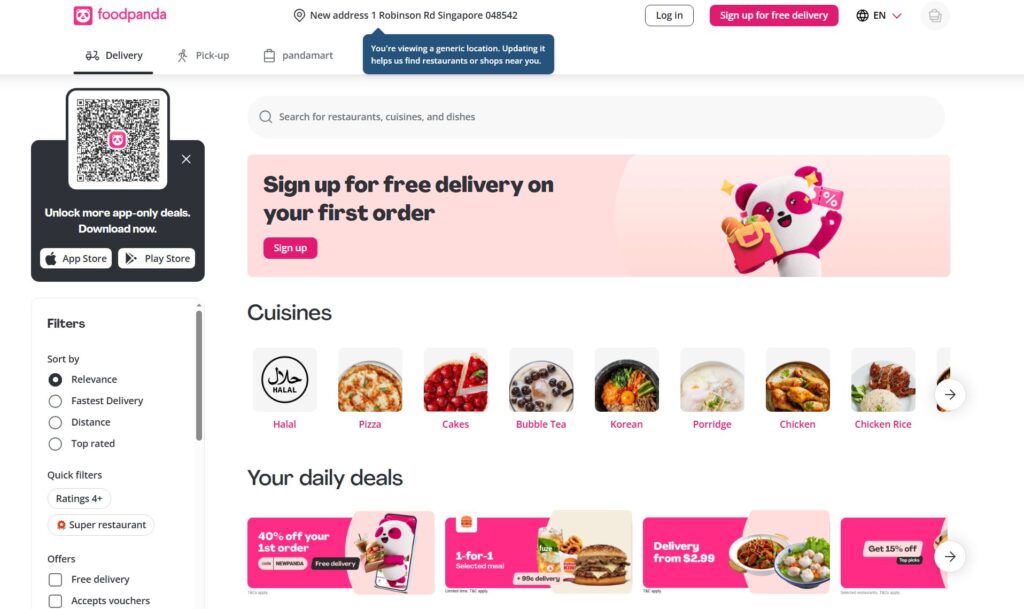
Remember when ordering food meant actually calling a restaurant and hoping someone answered?
Dark times.
Now we tap a few buttons and watch our dinner travel across the city in real-time, arriving exactly when promised. The transformation from “I’ll pick it up myself” to “I can’t believe I ever left my couch” happened remarkably fast.
And somewhere in that transformation, platforms like FoodPanda built multi-million dollar businesses by simply connecting hungry people with restaurants willing to deliver.
FoodPanda generates $74,000 monthly in Singapore alone—and that’s just one market for a platform operating across Asia.
Here’s what makes this case study fascinating…
FoodPanda didn’t invent food delivery. They didn’t even invent online food ordering. What they did was create a marketplace platform that made delivery so convenient that cooking dinner became the backup plan instead of the default.
Most restaurants have always offered delivery, but coordinating it themselves was painful. Most customers have always wanted delivery, but calling restaurants and explaining their address was annoying. FoodPanda simply eliminated all that friction—and charged both sides for the privilege.
So how does a marketplace platform generate six figures monthly by connecting two groups that already wanted to transact?
Let’s break down the model.
Ad 🎯 After studying 400+ business models, here’s what actually works for beginners…
Most “make money online” advice is garbage. Complex affiliate schemes. Dropshipping nightmares. Social media “influencing.”
We found something better: lead-generation funnels for manufacturers. Simple. Profitable. Fast results.
Our Max Incubator Phase 1 students are proof—they’re going from zero to their first $1,000 in 90 days with this exact model.
→ See the business idea that’s working for beginners this year
What FoodPanda Actually Does (And Why Marketplaces Print Money)
FoodPanda is a two-sided marketplace connecting customers who want food delivered with restaurants willing to deliver it.
That simple description undersells the complexity of what they’ve built, but it captures the essence. They’re not a restaurant. They’re not a delivery company. They’re the platform that makes both sides more efficient.
For customers, FoodPanda provides a single interface to browse menus from hundreds of restaurants, place orders with a few taps, pay digitally without fumbling for cash, and track delivery in real-time. This beats calling restaurants individually, explaining your order multiple times, repeating your address, and wondering when food will actually arrive.
For restaurants, FoodPanda provides access to customers they’d never reach otherwise, order management through a simple tablet interface, delivery logistics they don’t have to manage themselves, and payment processing without maintaining their own systems.
This beats managing phone orders, maintaining delivery staff and vehicles, dealing with cash handling, and marketing to acquire delivery customers.
The genius is that FoodPanda makes money by making both sides more efficient. Customers pay delivery fees for convenience. Restaurants pay commissions for access to demand. Both sides win, and FoodPanda captures value from facilitating the transaction.
According to research from Statista on food delivery markets, online food delivery is projected to reach $1.45 trillion globally by 2027, growing at 9.49% annually—demonstrating massive market opportunity for marketplace platforms.
The Revenue Model: How Marketplaces Scale Without Inventory
Let’s talk about how FoodPanda generates $74,000 monthly through the marketplace model.
Understanding this is critical because marketplaces are fundamentally different from traditional e-commerce businesses.
Revenue Stream #1: Restaurant Commissions
FoodPanda charges restaurants a percentage commission on every order placed through the platform.
Commission rates typically range from 20-35% depending on the restaurant’s agreement and service level. This might seem high, but restaurants pay it willingly because they’re acquiring customers they wouldn’t reach otherwise and avoiding the overhead of managing their own delivery operations.
The beautiful part about commission-based revenue is that it scales with transaction volume without requiring inventory investment. More orders equals more revenue, but FoodPanda never owns the food or manages the kitchen operations.
Revenue Stream #2: Customer Delivery Fees
Customers pay delivery fees that vary based on distance, order value, and demand.
These fees typically range from $2-8 per delivery, with surge pricing during peak times or bad weather when demand exceeds driver availability. Many platforms also implement minimum order values to ensure delivery fees make economic sense.
Delivery fees serve two purposes—they generate direct revenue while helping manage demand by discouraging very small orders that aren’t economically viable to fulfill.
Revenue Stream #3: Advertising and Premium Placements
Restaurants can pay for premium placement in search results, featured positioning on the homepage, or promotional campaigns within the app.
This creates a third revenue stream beyond commissions and delivery fees. Restaurants competing for visibility in a crowded marketplace will pay for advantageous positioning that drives more orders to them specifically.
According to Euromonitor research on delivery platforms, advertising and premium placement now represents 15-20% of revenue for mature food delivery marketplaces—a growing stream as platforms monetize their audience attention.
What FoodPanda Does Brilliantly
Despite intense competition in the food delivery space, FoodPanda executes several strategies exceptionally well.
Obsessive Focus on User Experience
FoodPanda’s app is fast, intuitive, and eliminates friction from the ordering process.
Browsing restaurants is visual and engaging with photos of dishes. Filtering by cuisine, price, or delivery time helps customers find exactly what they want. One-tap reordering from favorites makes repeat purchases effortless. Real-time tracking provides transparency and reduces anxiety about delivery timing.
Every interaction is designed to minimize the effort required to get food delivered. This keeps customers using the platform rather than calling restaurants directly or using competitor apps.
Data-Driven Personalization
FoodPanda uses customer data to provide personalized recommendations.
The app suggests restaurants based on past orders, current time of day, and dining preferences. Promotions are targeted to individual users based on behavior and preferences. Search results prioritize options likely to appeal to specific customers.
This personalization improves conversion rates dramatically compared to showing identical results to all users regardless of preferences.
Strategic Restaurant Partnerships
FoodPanda partners with both restaurant chains and independent eateries, creating comprehensive selection.
Major chains provide brand recognition and high order volumes. Local favorites attract customers seeking specific cuisines or neighborhood spots. This mix ensures the platform appeals to different customer segments with different dining preferences.
The breadth of restaurant selection creates network effects—customers choose FoodPanda because all their restaurant options are available in one app, and restaurants join because all the customers are already using the platform.
Multiple Payment Options
FoodPanda integrates credit cards, digital wallets, and cash payment options.
This removes payment as a barrier to conversion. Customers can pay however they prefer without needing to change habits. Integration with local payment methods (like popular e-wallets in Asian markets) makes transactions seamless for local customers.
Rapid Expansion Beyond Core Food Delivery
FoodPanda expanded into grocery and essential item delivery, especially during periods of high demand.
This diversification serves multiple purposes—it increases platform utility beyond restaurant meals, captures larger basket sizes and higher-margin categories, reduces customer churn by becoming essential infrastructure rather than occasional convenience, and leverages existing delivery logistics for additional revenue streams.
According to McKinsey research on food delivery evolution, platforms that expanded beyond restaurant delivery saw 40% higher customer retention and 25% higher average order values compared to food-only competitors.
What FoodPanda Could Improve (The Revenue Accelerators)
Despite massive success, FoodPanda has room to expand revenue and customer value.
AI-Powered Meal Planning and Personalization
Imagine an AI that learns your dietary preferences, nutritional goals, and eating patterns, then proactively suggests meals.
Based on your past orders, current time, weather, and even mood indicators, the AI could recommend specific dishes from specific restaurants you’re likely to enjoy. For health-conscious users, it could suggest nutritionally balanced options. For busy professionals, it could predict when you’ll want dinner and pre-suggest options.
This level of personalization would increase order frequency by reducing decision fatigue and making ordering feel less transactional and more like a personal service.
Augmented Reality Restaurant Previews
AR technology could let customers virtually preview restaurant ambience and food presentation before ordering.
Imagine pointing your phone at your dining table and seeing exactly how a dish would look plated in your own space. Or taking a virtual tour of a restaurant’s dining room to decide if you’d want to dine in there later.
This bridges the gap between online ordering and in-person dining experiences, potentially increasing customer confidence in trying new restaurants.
Subscription Meal Programs
FoodPanda could offer subscription programs for different customer segments.
Busy professionals could subscribe to weekday lunch delivery. Health-conscious users could subscribe to balanced meal plans. Families could subscribe to kid-friendly dinner options. Each subscription would guarantee certain order volumes for partner restaurants while creating predictable revenue for FoodPanda.
Subscription models also improve customer lifetime value dramatically by creating ongoing commitment rather than transactional relationships.
Ad 🎯 Ready to put these strategies into action?
Theory is great, but execution is what drives growth. That’s where Max Business School™ comes in.
Inside, you’ll find step-by-step digital marketing courses (SEO, ads, email, social, content, and more) — taught by professionals, designed for beginners and business owners alike.
And the best part? It’s 100% free, online, and flexible.
→ Join Max Business School Today — Free
Your Blueprint for Building a Food Delivery Marketplace
Ready to build your own delivery marketplace?
Here’s your blueprint based on what FoodPanda does right and where opportunities exist.
Step 1: Choose Your Market and Niche
Don’t try to compete with Uber Eats nationally from day one.
Start with one city or neighborhood where you can build density. Consider focusing on an underserved niche—healthy meal delivery, late-night food, office lunch catering, or specific cuisine types. Density in one area beats thin coverage across large geography.
Step 2: Build Your Two-Sided Platform
You need both restaurants and customers to launch successfully.
Start by recruiting 10-20 popular restaurants in your target area. Create a simple ordering interface that works on mobile and desktop. Integrate real-time order tracking and communication. Build or integrate payment processing supporting multiple methods.
Your platform doesn’t need every feature initially—it needs to facilitate orders reliably.
Step 3: Solve the Delivery Challenge
You have several options for managing delivery logistics.
Partner with existing delivery services to handle fulfillment. Recruit independent contractors as delivery drivers. Work with restaurants that provide their own delivery. Or use a hybrid model combining multiple approaches.
The goal is reliable delivery without massive upfront investment in vehicles and staff.
Step 4: Implement Your Revenue Model
Set commission rates that restaurants will accept while remaining profitable.
Charge delivery fees that cover logistics costs without making orders prohibitively expensive. Consider minimum order values to ensure delivery economics work. Test pricing to find the balance between volume and profitability.
Your goal is sustainable unit economics—each order should contribute positively to covering fixed costs.
Step 5: Focus on User Experience
Make ordering as frictionless as possible.
Ensure fast page loads and quick checkout. Provide real-time order tracking and updates. Enable one-tap reordering from past favorites. Offer personalized recommendations based on behavior.
The platform with the smoothest experience wins the most repeat orders.
Step 6: Build Network Effects
The value of your platform increases as both sides grow.
More restaurants attract more customers. More customers attract more restaurants. Focus on building this virtuous cycle in your target market before expanding geographically.
Network effects create defensibility that prevents competitors from easily displacing you once established.
Step 7: Expand Strategically
Once you’ve achieved density in one market, replicate the model elsewhere.
Expand to adjacent neighborhoods or cities with similar demographics. Consider expanding into related categories like grocery or alcohol delivery. Always prioritize depth over breadth—dominate one area before spreading thin.
Key Takeaways: Building Your Marketplace
Marketplaces win by making both sides more efficient. FoodPanda succeeds because they make ordering easier for customers and customer acquisition easier for restaurants. Focus on solving real problems for both sides.
User experience determines market leadership. In crowded markets, the platform with the smoothest experience captures the most customers. Invest heavily in eliminating friction from every interaction.
Network effects create defensibility. Once customers expect all restaurants to be on your platform and restaurants expect all customers to use it, competitors struggle to gain traction.
Data enables personalization at scale. Understanding customer preferences allows you to make relevant recommendations that increase order frequency and basket size.
Category expansion leverages existing infrastructure. Adding grocery or essential delivery uses the same logistics while serving more customer needs and increasing retention.
The global food delivery market is massive and growing, with platforms like DoorDash, Uber Eats, and Deliveroo proving the model works at scale. But there’s still opportunity for focused local players serving specific markets or niches better than generalist platforms.
Your Turn to Build
Here’s the beautiful truth about marketplace platforms…
You don’t need to own inventory, manage restaurants, or employ thousands of delivery drivers to build something valuable. You need to connect two groups that want to transact and make that transaction easier than the alternatives.
FoodPanda built a massive business by doing exactly that—making food delivery so convenient that it became the default rather than the exception.
The question isn’t whether delivery marketplaces can succeed.
The question is: which underserved market will you connect?
Your move.