
How to Earn $21k Monthly in Finance Blogging: Couple Makes $252k Yearly
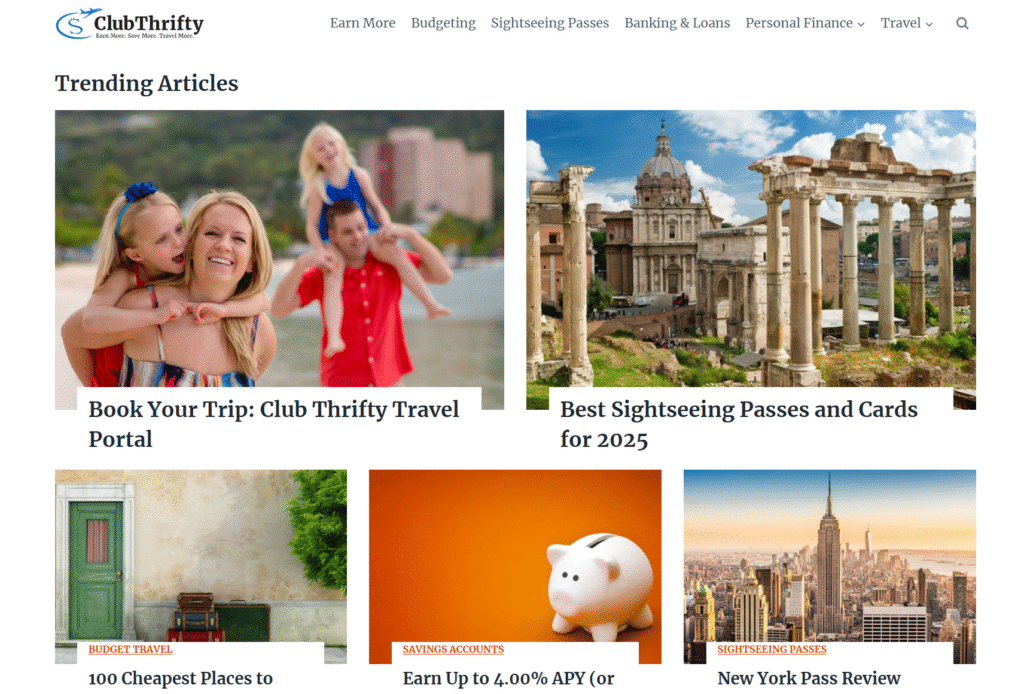
Most financial advice comes from people who’ve never been broke.
Greg and Holly Johnson are different.
They built Club Thrifty from a simple premise: teach people how to escape debt and build wealth using strategies they’d actually tested themselves. Today, their finance blog generates $21,000 monthly—that’s over a quarter million dollars annually.
No trust fund. No MBA from an Ivy League school. Just practical money knowledge, strategic content creation, and multiple revenue streams working in harmony.
The beautiful part? They work remotely while traveling the world with their kids, proving you don’t need to sacrifice family time or adventure to build serious wealth.
Here’s how they turned personal finance blogging into a six-figure business (and how you could build something similar).
Ad 🎯 After studying 400+ business models, here’s what actually works for beginners…
Most “make money online” advice is garbage. Complex affiliate schemes. Dropshipping nightmares. Social media “influencing.”
We found something better: lead-generation funnels for manufacturers. Simple. Profitable. Fast results.
Our Max Incubator Phase 1 students are proof—they’re going from zero to their first $1,000 in 90 days with this exact model.
→ See the business idea that’s working for beginners this year
The Business Model That Turns Money Stress Into Monthly Income
Picture making more in a month than most people earn in six months—while helping thousands escape the debt trap that keeps them awake at night.
That’s Club Thrifty’s reality.
The business operates at the intersection of personal finance education and online business training. While most finance blogs stop at budgeting advice, Greg and Holly teach readers how to earn more money through side hustles, freelancing, and online business.
This positioning is brilliant because it addresses both sides of the wealth equation.
You can only cut expenses so far. But income? Income has no ceiling. By combining debt reduction strategies with income expansion tactics, Club Thrifty solves the complete financial puzzle—not just half of it.
The revenue model blends several streams into a substantial monthly haul:
Online courses hosted on Teachable generated $48,800 in a single year, with Greg teaching blogging/online income strategies while Holly leads a freelance writing course. These courses represent the highest-profit margin revenue—create once, sell indefinitely.
Affiliate marketing creates recurring passive income through partnerships with platforms like Swagbucks (which pays 10% recurring commissions on referral earnings) and Qmee. Unlike one-time affiliate payments, recurring commissions compound into serious money as your referral base grows.
Sponsored content and display advertising add another income layer, monetizing the substantial traffic their content attracts.
Personal consulting and workshops allow them to charge premium rates for one-on-one financial planning and budgeting advice.

When one revenue stream has a slow month, three others pick up the slack. It’s diversification done right.
Why the Couple-Powered Business Model Works
Here’s something most solo entrepreneurs overlook: partnership doubles your content capacity, skillset diversity, and audience appeal.
Greg and Holly didn’t just build a business together—they created complementary content channels that serve different audience segments.
Holly, an award-winning writer with serious credentials, teaches freelance writing and creates content about credit card rewards and travel hacking. Her expertise attracts aspiring writers and travel enthusiasts who want to fund adventures through smart spending strategies.
Greg focuses on blogging monetization, affiliate marketing, and building online businesses. His content pulls in entrepreneurs and side hustlers looking to create income streams beyond their day jobs.
Together, they’ve essentially built two audience pipelines that feed into the same monetization ecosystem.
This means their courses appeal to different buyer personas—people wanting to make money writing versus people wanting to build profitable blogs. Their affiliate recommendations work for multiple contexts. Their consulting services can address varied financial situations.
The couple dynamic also builds trust faster than a faceless brand ever could. Readers see real people—with kids, mortgage payments, and the same financial struggles everyone faces—who figured out how to build wealth and are sharing the playbook.
That authenticity is worth more than any marketing budget could buy.
The Course Strategy That Prints Money on Autopilot
Let’s talk about why online courses are the secret weapon of successful bloggers.
Most finance blogs monetize through affiliate links and advertising. Those work, sure. But they require constant traffic growth to increase income. More traffic equals more clicks equals more revenue—it’s linear scaling.
Courses break that model.
Once created, a course sells infinitely without requiring more of your time. Sale number one and sale number one hundred demand the same effort: zero. This is what separates bloggers making $5,000 monthly from those crossing $20,000+.
Club Thrifty hosts courses on Teachable, a platform that handles all the technical complexity—payment processing, content delivery, student management. This lets Greg and Holly focus on what matters: creating valuable educational content.
Greg’s course teaches blogging and online income generation—taking people from complete beginners to earning their first dollars online. He’s not selling theory—he’s teaching the exact strategies he used to build Club Thrifty.
Holly’s freelance writing course taps into massive market demand. Millions of people want to earn money writing but have no clue how to land clients, set rates, or structure their services. She removes the guesswork by sharing her proven system.
The genius move? Both courses naturally lead students to need the tools and services Club Thrifty promotes through affiliate partnerships. Someone learning to blog will need website hosting, email marketing software, and SEO tools. Someone building a writing business needs invoicing software and project management platforms.
The courses don’t just generate direct revenue—they create highly qualified audiences for affiliate recommendations.
That’s the kind of strategic thinking that separates $21,000 months from $2,000 months.
The Affiliate Strategy Focused on Recurring Commissions
Most bloggers approach affiliate marketing backwards.
They promote whatever has the highest commission rate, regardless of whether it makes sense for their audience. A $50 commission on a product nobody needs is worth exactly zero dollars.
Greg and Holly focus relentlessly on two criteria: genuine value for readers and recurring commission structures.
The recurring part is what changes everything.
One-time affiliate commissions are fine. You refer someone, they buy, you get paid once. But recurring commissions? You refer someone once, and you get paid every single month as long as they remain a customer.
Swagbucks exemplifies this approach perfectly. The platform pays 10% of whatever your referrals earn through the site. If you refer someone who consistently makes $50 monthly through Swagbucks activities, you’re earning $5 monthly from that single referral—forever.
Now multiply that by hundreds or thousands of referrals.
See how the math gets interesting?
This is why successful finance bloggers obsess over software, subscription services, and platforms that pay recurring commissions. The income compounds over time without requiring additional effort.
Club Thrifty also promotes financial tools like Qmee and various survey platforms that help readers earn extra money. These aren’t random recommendations—they align perfectly with the blog’s mission of helping people increase income and reduce debt.
When your affiliate recommendations genuinely help readers solve problems, conversion rates skyrocket. People trust your suggestions because they know you’re not just chasing commissions—you’re curating solutions.
That trust, built over dozens of helpful articles, is what transforms casual readers into buyers who actively seek out your affiliate links before making purchase decisions.
The Content Approach That Simplifies Complexity
Finance content has a terrible reputation.
Most of it is either mind-numbingly boring (think corporate banking blog posts written by compliance departments) or unnecessarily complicated (financial “experts” flexing vocabulary instead of helping readers).
Club Thrifty takes the opposite approach: they make complex financial topics accessible and actionable.
Their popular posts break down intimidating subjects—debt payoff strategies, credit card rewards optimization, side hustle ideas—into clear steps anyone can follow. No financial jargon unless absolutely necessary. No condescending tone that makes readers feel stupid for not understanding economics.
Just straightforward guidance from people who remember what it’s like to struggle with money.
This content philosophy drives impressive engagement because readers actually finish articles and implement the advice. They’re not just consuming content for entertainment—they’re using it to improve their financial situations.
That’s the difference between traffic that generates revenue and traffic that just inflates vanity metrics.
Club Thrifty also diversified into the “make money online” niche, sharing practical strategies for building side income through freelancing, blogging, and online businesses. This expansion made perfect sense—their audience actively wants to earn more money, so teaching proven income strategies serves reader needs while opening up entirely new affiliate opportunities.
The content strategy also emphasizes personal experience over theoretical advice. Greg and Holly share real numbers from their own journey—how much they earned from various side hustles, which strategies flopped, what worked better than expected.
This transparency builds credibility that theoretical advice could never match.
The Consultation Model That Captures High-Value Clients
Courses and affiliate income are excellent, but they leave money on the table.
Some people need (and will pay for) personalized guidance. They don’t want a general course—they want specific answers to their unique financial situations.
Club Thrifty captures this market through one-on-one consultations and workshops.
These services command premium pricing because they’re highly customized. Instead of generic budgeting advice, clients receive tailored financial plans addressing their specific income, expenses, debt obligations, and goals.
The consultation model also serves a strategic business purpose: it provides direct insight into audience pain points.
What questions do people ask repeatedly? Which financial challenges cause the most anxiety? What topics confuse people despite available content? Every consultation is essentially market research that informs future blog posts, course modules, and product development.
Plus, consultation clients often become the most enthusiastic testimonials and case studies. Someone who worked directly with you and achieved results becomes a powerful referral engine, recommending your services to friends and family facing similar challenges.
The workshops extend this model to group settings, allowing Greg and Holly to serve multiple clients simultaneously while maintaining higher engagement than pure online courses offer.
This is how you build a business with no revenue ceiling—high-volume low-ticket products (affiliate commissions), mid-tier offerings (courses), and premium services (consultations) all working together.
The Growth Opportunities Still on the Table
Even at $21,000 monthly, Club Thrifty has obvious expansion opportunities.
The biggest missed opportunity? Social media presence.
According to traffic analysis, the blog relies heavily on organic search traffic while barely leveraging social platforms. This is baffling because personal finance content performs exceptionally well on platforms like Pinterest, Instagram, and TikTok.
Quick budgeting tips, debt payoff milestones, side hustle ideas—this content is tailor-made for social sharing. A strategic social media approach could easily drive 50-100% more traffic to the site without significant advertising spend.
The visual nature of progress (paying off debt, hitting savings goals) also lends itself perfectly to before/after style content that goes viral. People love sharing financial wins, and Club Thrifty could become the platform people tag when celebrating money milestones.
The second major opportunity? SEO optimization.
Traffic data shows a declining trend in organic search visibility. This happens when competitors publish more content, target keywords more effectively, or build stronger backlink profiles.

The fix involves several strategic moves: updating older posts with current information and better keyword targeting, building more backlinks through guest posting and digital PR, creating comprehensive pillar content that targets high-volume keywords, and improving technical SEO elements like page speed and mobile optimization.
Simple keyword research and content gap analysis would reveal dozens of high-traffic topics Club Thrifty isn’t currently ranking for—each representing potential traffic (and revenue) they’re leaving on the table.
The third opportunity? Video content.
Finance advice translates exceptionally well to video format. YouTube represents a massive search engine where people actively seek money management guidance. Creating video versions of top-performing blog posts would tap into an entirely new audience segment while building another traffic source that feeds affiliate and course sales.
None of these opportunities require revolutionary ideas—just consistent execution on proven strategies. The foundation is already there; it’s just about amplifying what works.
Ad 🎯 Ready to put these strategies into action?
Theory is great, but execution is what drives growth. That’s where Max Business School™ comes in.
Inside, you’ll find step-by-step digital marketing courses (SEO, ads, email, social, content, and more) — taught by professionals, designed for beginners and business owners alike.
And the best part? It’s 100% free, online, and flexible.
→ Join Max Business School Today — Free
What You Can Actually Learn From This Success
Let’s distill the key lessons worth stealing:
Simplify complex topics ruthlessly. If readers need a finance degree to understand your content, you’ve failed. Break down complicated concepts into clear steps. Use examples. Avoid jargon. Make readers feel smart for understanding, not stupid for asking.
Service delivery is your differentiator. Hundreds of finance blogs exist. What makes you different? Club Thrifty stood out by offering courses, consultations, and workshops—services that actually transform financial situations rather than just providing information.
Build multiple revenue streams. Never rely on a single income source. Courses, affiliates, advertising, consultations—each protects against downturns in others. Diversification isn’t just an investment strategy; it’s a business survival tactic.
Prioritize recurring affiliate commissions. One-time payments are fine, but recurring commissions compound into serious passive income. Focus on software, subscriptions, and services that pay monthly.
Personal experience beats theoretical knowledge. Share real numbers, actual strategies you’ve tested, and honest results including failures. Transparency builds trust faster than polished perfection ever could.
Partnership multiplies impact. Two people create more content, bring complementary skills, appeal to broader audiences, and prevent burnout better than solo entrepreneurs. Consider whether partnership could accelerate your business.
The beautiful thing about blogging? The strategies that work in personal finance apply to virtually any niche—health, parenting, technology, travel. The fundamentals remain constant: create genuinely helpful content, build trust through consistency, monetize through multiple channels.
The Skills That Separate Winners From Wannabes
Building a six-figure finance blog requires developing three core competencies:
Content creation and communication skills: You need to research topics thoroughly, organize information logically, and present complex concepts in accessible language. Personal finance has high stakes—people are making real money decisions based on your advice. Mediocre explanations don’t cut it.
Digital marketing knowledge: Understanding SEO, email marketing, social media strategy, and conversion optimization determines whether your excellent content reaches anyone. Great content that nobody sees earns exactly zero dollars.
Product development abilities: Creating courses, digital products, and consultation services requires understanding what formats work for different learning styles, how to price offerings appropriately, and how to market effectively without being pushy.
None of these skills are innate—they’re learned through practice, study, and iteration. The people who succeed are those who view skill development as an ongoing process rather than a one-time checklist.
You’ll make mistakes. You’ll create content nobody reads. You’ll launch products that don’t sell. That’s part of the process. The winners are simply those who analyzed what went wrong, adjusted their approach, and tried again.
Industry Context: Why Finance Blogging Still Works
The personal finance blogging space has matured significantly since the early 2010s, but opportunity hasn’t disappeared—it’s just evolved.
According to industry data, personal finance remains one of the most searched topics online, with millions of people actively seeking advice about budgeting, investing, debt reduction, and earning more money.
This creates sustained demand for quality financial education, especially from sources that feel accessible rather than intimidating.
The key is positioning. “Personal finance blog” is too broad and competitive. But “personal finance for freelancers,” “debt elimination for millennials,” or “financial independence for families” are specific enough to stand out.
Club Thrifty succeeded by combining personal finance with online income education—serving people who want to improve their financial situation through both better money management and increased earnings.
Looking at the broader landscape, successful finance blogs like Making Sense of Cents (which reportedly earns over $100,000 monthly) and The Penny Hoarder demonstrate the massive potential in this niche.
The industry hasn’t become saturated—it’s become more competitive. Success now requires better strategy, clearer positioning, and higher-quality execution than a decade ago. But for those willing to do the work, the financial rewards are substantial.
The affiliate commission rates in finance are also attractive. Credit cards, financial software, investment platforms, and banking products often offer $50-200+ per conversion, significantly higher than most other niches.
The Bottom Line: Your Financial Freedom Playbook
Greg and Holly Johnson’s success with Club Thrifty proves that ordinary people with financial knowledge and solid work ethic can build extraordinary income through strategic content creation.
They started without massive platforms, industry connections, or special advantages. They simply committed to helping people solve real financial problems, stayed consistent even when growth was slow, and built multiple revenue streams that compound into serious monthly income.
$21,000 monthly didn’t happen overnight. It came from years of publishing helpful content, refining monetization strategies, developing valuable courses, and building trust with thousands of readers.
Could you replicate their exact business? Probably not—Club Thrifty has established significant authority and audience relationships over many years. But could you apply their fundamental strategies to build a profitable finance blog? Absolutely.
The formula works: Pick a specific financial niche you understand deeply. Create genuinely helpful content consistently. Build trust through transparency and personal experience. Monetize through courses, affiliates, and services. Stay patient through the inevitable slow growth phase.
Most people quit after six months because they’re not seeing results. The six-figure bloggers are simply those who refused to quit—who kept publishing, kept learning, kept optimizing even when traffic was tiny and income was nonexistent.
So the question isn’t whether finance blogging works. The question is whether you’re willing to do the work required to make it work for you.
The path to $21,000 monthly exists. It’s just paved with hundreds of blog posts, dozens of failed experiments, and years of consistent effort that most people aren’t willing to invest.
Your move.