
How to Earn $3K+ Monthly as a Digital Nomad Blogger
Ever scrolled through Instagram and felt that painful twinge of jealousy watching someone sip coconut water on a Thai beach while you’re stuck in a fluorescent-lit cubicle eating sad desk salad?
Yeah, me too.
But here’s what Instagram doesn’t tell you: some of those people aren’t trust fund babies or lottery winners. They’re digital nomads who figured out how to turn travel blogging into actual, spendable income.
We’re talking $3,000+ per month. Every month. While wandering the planet.
Let me show you exactly how one former Washington D.C. political worker ditched the power suits for hiking boots and built a travel blog that funds his adventures.
Ad 🎯 After studying 400+ business models, here’s what actually works for beginners…
Most “make money online” advice is garbage. Complex affiliate schemes. Dropshipping nightmares. Social media “influencing.”
We found something better: lead-generation funnels for manufacturers. Simple. Profitable. Fast results.
Our Max Incubator Phase 1 students are proof—they’re going from zero to their first $1,000 in 90 days with this exact model.
→ See the business idea that’s working for beginners this year
The Truth About Digital Nomad Income
Let’s establish something important right up front.
Most travel blogs make exactly zero dollars. They’re digital diaries that cost money to maintain and generate nothing but likes from Mom. That’s fine if blogging is your hobby, but it’s useless if you’re trying to fund a lifestyle of location independence.
But some travel blogs crack the code.
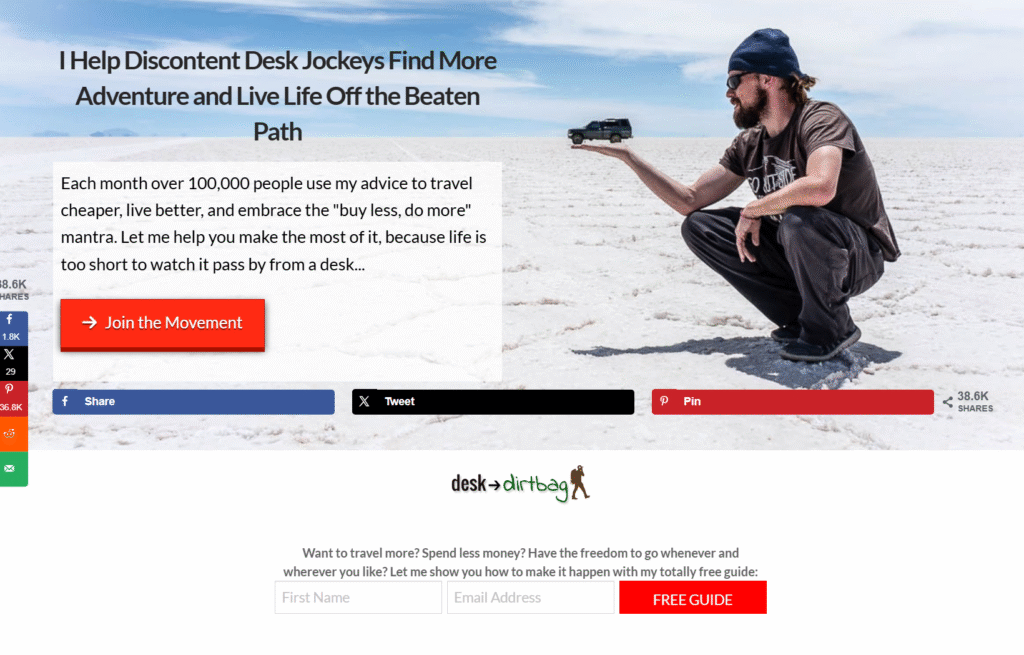
Desk to Dirtbag, founded by Ryan, is one of them. This blog generates at least $3,000 monthly through a combination of smart monetization strategies that don’t rely on begging followers to “buy me a coffee.”
The best part? This isn’t rocket science. It’s a replicable model that anyone with dedication and strategic thinking can build.
How Digital Nomad Blogs Actually Make Money
Strip away the Instagram aesthetics and sunset photos, and you’ll find three core revenue streams powering this lifestyle.
Digital Products: Selling Packaged Expertise
Ryan’s flagship product is “Big Travel Small Budget,” a comprehensive travel guide that solves a specific problem: how to see the world without liquidating your retirement account.
This is digital product creation at its finest.
Instead of trading time for money through freelance writing or consulting, you create something once and sell it repeatedly. While you’re sleeping in a hostel in Budapest, someone in Ohio is buying your e-book and depositing money in your account.
The key is solving a genuine problem for your target audience. Generic travel advice is worthless. Specific, actionable guidance on budget travel? That’s valuable.
According to industry research on digital products, e-books remain one of the most accessible entry points for content creators looking to monetize their expertise. Low overhead, high margins, infinite scalability.
Affiliate Marketing: Earning While You Recommend
When Desk to Dirtbag recommends camping gear from REI, those aren’t just helpful suggestions.
They’re affiliate partnerships that generate commission on every sale.
The blog partners with companies that align with its budget travel mission. When readers click through to purchase a recommended tent or backpack, Ryan earns a percentage. It’s a win-win: readers discover quality products, and the blog generates passive income.
But here’s the critical distinction between effective affiliate marketing and desperate link-spamming:
Authenticity matters.
Ryan only recommends products he genuinely uses and believes in. This builds trust with his audience, which converts at much higher rates than random product placements. According to affiliate marketing statistics, 83% of consumers trust recommendations from people they know, while only 66% trust company advertising.
Display Advertising: The Foundation Revenue Stream
Through Mediavine, an advertising network for content creators, Desk to Dirtbag earns an average of $3,000 monthly just from display ads.
Let’s break down what that means.
Every time someone visits the blog to read about budget camping tips or digital nomad destinations, ads display. Those impressions generate revenue even if the visitor doesn’t buy anything or click affiliate links.
This is passive income in its purest form. Create valuable content once, and it generates ad revenue month after month as long as people keep finding it through search engines.
The catch? You need consistent traffic to make display ads worthwhile. But once you hit those thresholds, it becomes a beautiful compounding effect.
What Desk to Dirtbag Did Brilliantly
Success in travel blogging isn’t about taking prettier photos than the next person. It’s about smart business decisions disguised as wanderlust.
Building an Integrated Online Shop
Instead of sending readers to third-party platforms, the blog features a built-in shop where visitors can browse and purchase products directly.
Stickers, camping gear, clothing, even coffee machines.
This creates multiple touchpoints for monetization without disrupting the user experience. A reader might come for a blog post about budget camping and leave with a purchase from the integrated shop.
It’s frictionless commerce that serves the audience while generating revenue.
The Donation Model for True Fans
Here’s something most bloggers overlook: some readers genuinely want to support your work.
Desk to Dirtbag includes a donation section on the website, giving audience members the opportunity to contribute directly. While this might not be the primary revenue driver, it serves two purposes.
First, it generates some additional income from your most devoted followers. Second, it deepens the relationship with readers who feel invested in your continued success.
According to creator economy research, platforms enabling direct support from fans have exploded in popularity precisely because audiences want to sustain creators they value.
Content That Delivers Actual Value
This is where most travel blogs fail spectacularly.
They post pretty photos with vague captions like “Chasing sunsets in Bali ✨” and wonder why nobody’s buying anything. Desk to Dirtbag takes a different approach by delivering genuinely useful content that solves real problems.
The blog posts offer:
- Specific travel hacks that save money
- Detailed destination guides
- Practical camping advice
- Budget travel strategies
And here’s the genius part: the blog integrates its digital product into posts, allowing readers to enhance their knowledge by purchasing the comprehensive guide.
This isn’t manipulation. It’s value stacking.

You provide free, helpful content that establishes credibility. Then you offer a deeper dive for those who want more. With 12,000+ monthly visitors from organic search, this approach clearly resonates.
The Massive Opportunities Being Ignored
Even with $3,000+ in monthly revenue, Desk to Dirtbag is leaving serious money on the table.
Email Marketing: The Sleeping Revenue Giant
The blog has a newsletter, but it’s not being leveraged to its full potential.
Here’s what most bloggers don’t understand about email: it’s the highest-converting marketing channel by a massive margin. According to email marketing statistics, email generates $36 for every $1 spent.
That’s a 3,600% ROI.
The solution? Implement strategic opt-in forms that appear at key engagement moments. Offer exclusive content or incentives for subscribing—think free budget travel checklists or access to premium destination guides.
Then send engaging, informative newsletters consistently. Not daily spam, but valuable content that keeps subscribers engaged and primed for occasional product recommendations.
Social Media Lead Generation
The blog exists on social media, but there’s no cohesive strategy for leveraging these platforms to drive traffic and build the email list.

Instagram, Pinterest, and YouTube are goldmines for travel content when used strategically. Create platform-specific content that showcases your unique value, then funnel that audience back to your blog and email list.
Short-form video content on TikTok and Instagram Reels particularly has explosive potential in the travel niche. Show quick travel hacks, budget breakdowns, or destination highlights that create curiosity and drive traffic.
Ad 🎯 Ready to put these strategies into action?
Theory is great, but execution is what drives growth. That’s where Max Business School™ comes in.
Inside, you’ll find step-by-step digital marketing courses (SEO, ads, email, social, content, and more) — taught by professionals, designed for beginners and business owners alike.
And the best part? It’s 100% free, online, and flexible.
→ Join Max Business School Today — Free
The Man Behind the Wanderlust
Ryan, the founder of Desk to Dirtbag, isn’t some wealthy influencer who started with advantages.
He worked in Washington D.C. politics before becoming a full-time traveler in 2013.
Think about that for a second.
He went from the structured world of political work to complete location independence. This wasn’t handed to him. He built it through strategic content creation, smart monetization, and consistent effort.
Today he travels the world full-time, fueled by coffee and books, generating income from content he created months or even years ago.
That’s the power of building digital assets.
Your Blueprint for Digital Nomad Income
Ready to swap your commute for passport stamps?
Here’s what actually matters when building a travel blog that generates income:
Start with a clear niche. “Travel blog” is too broad. Budget travel for millennials? Solo female backpacking? Digital nomad camping? Luxury travel on points? Get specific about who you’re serving and what problem you’re solving.
Create an e-book aligned with your niche. Identify your audience’s biggest pain point and create a comprehensive guide that solves it. This becomes your primary digital product and establishes you as an authority.
Build your platform on WordPress. You need control over your content and monetization. Social media platforms can change rules overnight, but a self-hosted website is yours forever. Invest in quality hosting and a clean, fast theme.
Optimize for search engines from day one. Every blog post should target specific keywords that your ideal readers are searching for. Use tools like Google Keyword Planner to identify opportunities, then create content that answers those queries better than anyone else.
Develop a lead magnet and grow your email list immediately. Offer something valuable—a packing checklist, budget breakdown template, or exclusive destination guide—in exchange for email signups. Then nurture that list with valuable content.
Monetize through multiple streams. Don’t rely solely on ads or affiliates or products. Build all three revenue streams so you’re not vulnerable to any single source drying up.
Provide genuine value in every piece of content. Nobody cares about your brunch or your hotel room. They care about solving their problems and achieving their travel goals. Make your content useful first, pretty second.
Be patient and consistent. Building a profitable travel blog takes time. Most people quit after three months, which is exactly why most people fail.
The Hard Truth About Digital Nomad Life
Let me rain on the parade for just a moment.
Being a digital nomad isn’t all coconuts and hammocks. It’s also spotty WiFi, loneliness, visa complications, and working when everyone else is partying. It requires discipline, business savvy, and the ability to work independently without a boss breathing down your neck.
But for those willing to put in the work?
It’s freedom.
The freedom to work from a cafe in Prague, a beach in Mexico, or a mountain cabin in Colorado. The freedom to structure your days around your energy and creativity rather than arbitrary office hours. The freedom to turn your wanderlust into a business asset rather than a financial liability.
Desk to Dirtbag proves this lifestyle is accessible to people without trust funds or inheritance. You don’t need to be independently wealthy to achieve location independence.
You just need to be strategic, consistent, and willing to treat your blog like the business it is.
The Choice Is Yours
You can keep watching other people live the life you want, or you can start building it yourself.
$3,000 per month won’t make you rich, but it covers the essentials in most countries while you explore, learn, and grow your business. And here’s the beautiful part: once you crack the code on one blog generating $3,000, you understand the playbook for scaling to $5,000, then $10,000, then beyond.
The opportunity exists right now.
The travel content market isn’t saturated with quality. It’s saturated with mediocrity. There’s infinite room for creators who actually deliver value instead of just posting sunset photos.
So what’s it going to be?
Another year of scrolling through other people’s adventures, or the start of funding your own?
Your future self already knows the answer.