
How One Woman Made $250K in 2 Years Selling Spreadsheets on Etsy
Here’s a question that’ll make you reconsider everything:
What if the path to six-figure income didn’t require a fancy degree, venture capital, or even leaving your house?
What if it just required… spreadsheets?
I know what you’re thinking. “Spreadsheets? Like, Excel files? Those boring things from accounting class that made me contemplate alternative career paths?”
Yes, exactly those.
Emily McDermott took the most unglamorous digital product imaginable and turned it into a $100,000+ per year business. Not through some complicated drop-shipping scheme or affiliate marketing maze. Just straightforward spreadsheets sold on Etsy.
Since launching in 2020, the business has made over 29,000 sales on Etsy and ranks in the top 0.1% of all Etsy sellers.
Let that sink in for a moment. Top 0.1%. Out of millions of Etsy shops selling everything from handmade jewelry to vintage furniture, a store selling budget spreadsheets is beating 99.9% of them.
The best part? She started this as a side hustle while working a full-time job. No business degree required. No massive investment needed. Just a clear understanding of what people actually want and the willingness to create it.
Ready to learn how she did it? Because what you’re about to read might just change your entire approach to making money online.
Ad 🎯 After studying 400+ business models, here’s what actually works for beginners…
Most “make money online” advice is garbage. Complex affiliate schemes. Dropshipping nightmares. Social media “influencing.”
We found something better: lead-generation funnels for manufacturers. Simple. Profitable. Fast results.
Our Max Incubator Phase 1 students are proof—they’re going from zero to their first $1,000 in 90 days with this exact model.
→ See the business idea that’s working for beginners this year
The Unsexy Product Category That’s Actually a Gold Mine
Let’s address the elephant in the room:
Spreadsheets are boring. Budget planners sound about as exciting as watching paint dry while filing your taxes.
And that’s precisely why this works.
Most existing budget spreadsheets on Etsy are not aesthetically pleasing and do not cater to the typical young woman looking to manage her finances—a pain point this business solved by developing eye-catching products.
Think about it. Personal finance is stressful. People know they should budget but the tools available look like they were designed in 1987 by someone who thought Comic Sans was “fun.”
Emily recognized this gap. She understood that people—especially young women trying to get their financial lives together—want tools that don’t make them feel like corporate drones. They want budget planners that actually look nice. That spark a little joy. That don’t make them hate themselves every time they open them.
So she created exactly that.
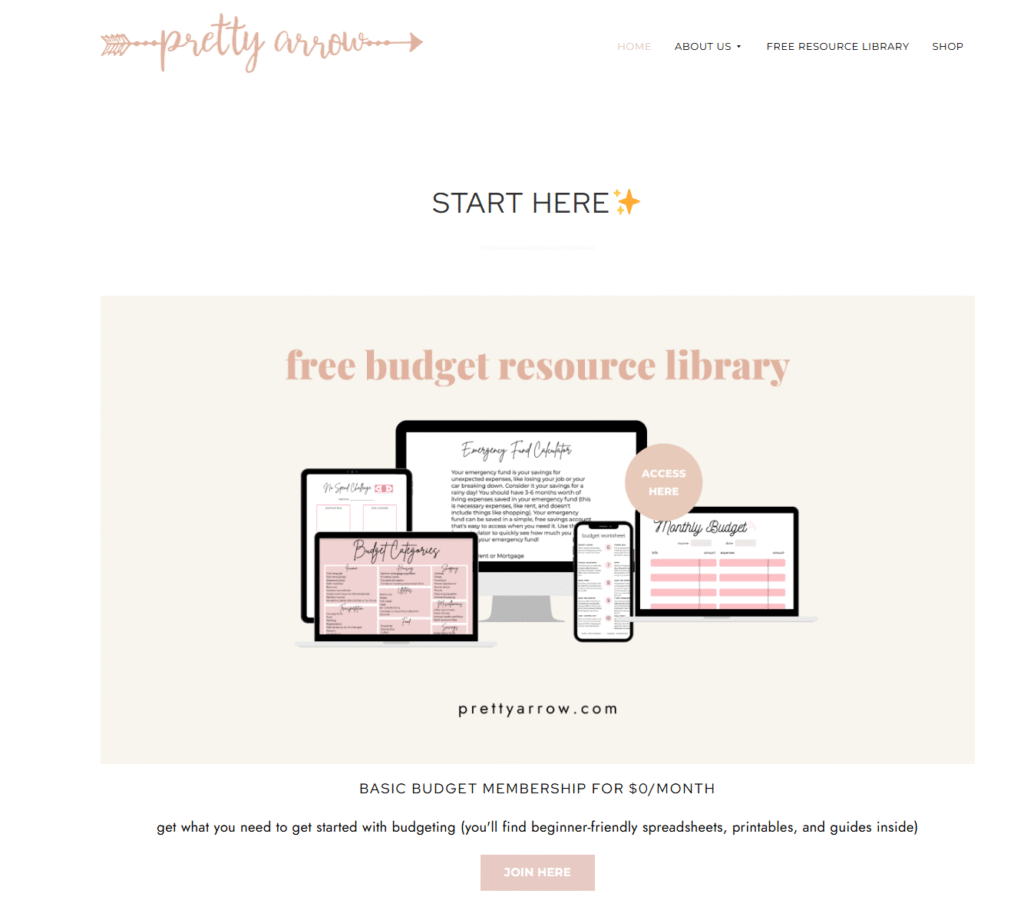
Her PrettyArrow store sells beautifully designed budget spreadsheets, financial planners, and debt payoff trackers. They’re functional, sure, but they’re also visually appealing in a way that makes you actually want to use them.
It’s the same principle that made Marie Kondo a household name—except instead of folding shirts, it’s organizing finances.
The Money: How PDF Files Generate Six Figures
Here’s where things get interesting from a business model perspective.
Revenue Stream #1: Individual Digital Products
The foundation of the business is straightforward: create digital products once, sell them infinitely.
The sale of printables is the major income source for this business, with the store making over 29,000 sales on Etsy since inception.
Individual products—budget planners, expense trackers, savings challenges—typically range from $5 to $15. Not huge margins per sale, but remember: these are digital products. Once created, there’s zero production cost, zero inventory, zero shipping.
Every sale is pure profit minus platform fees.
Sell a physical product and you’re dealing with manufacturing, storage, shipping, returns. Sell a digital spreadsheet and your only costs are platform fees (Etsy takes about 6.5% per transaction) and payment processing.
Create it once. Sell it forever. That’s the magic of digital products.
Revenue Stream #2: Premium Bundles (The Real Money Maker)
Here’s where the business model gets sophisticated.
The business earns the most from selling premium bundles that can cost up to $70 or more, consisting of several digital products sold together at a discounted rate.
This is brilliant psychology in action. Instead of buying a single budget planner for $8, customers can get the “Complete Financial Planning Bundle” with 10+ spreadsheets for $70. They feel like they’re getting a deal. The business quintuples its average order value.
Everyone wins.
These bundles serve different customer segments:
- Beginners who want everything to start budgeting from scratch
- Serious planners who want comprehensive financial tracking
- Gift buyers looking for a complete package for someone else
By offering both individual items and bundles, the store captures customers at every price point and commitment level.
Revenue Stream #3: Templates for Resellers
Now this is where it gets really clever.
Another income source for this business is the sale of spreadsheet templates to entrepreneurs that want to resell them for profit.
Emily sells the rights to her designs to other Etsy sellers who want to rebrand and resell them. It’s like licensing, except for budget spreadsheets.
Think about the genius here: she’s not just making money from end customers. She’s also making money from her potential competitors by selling them the tools to compete with her.
It’s the digital equivalent of Levi Strauss selling jeans to gold miners during the Gold Rush—except she’s selling the picks and shovels while also mining the gold herself.
Revenue Stream #4: Budget Coaching and Online Courses
But wait, there’s more.
The business owner also offers budget coaching services and an online course that teaches entrepreneurs how to successfully sell their own digital products.
The spreadsheet business became a proof of concept. Now Emily can charge for coaching and courses, teaching others the system she used to build her six-figure Etsy empire.
This is the ultimate leverage: turn your success into an educational product and sell that too.
The Strategy: How to Dominate Etsy (Even in Competitive Niches)
Success on Etsy isn’t random. There’s a specific playbook, and Emily executed it flawlessly.
Mastering the Etsy Algorithm
One secret behind the business’s success as a top 0.1% Etsy store is that the owner analyzes Etsy’s algorithm and optimizes the store accordingly, using Etsy keyword research tools, keyword optimization in product descriptions, coupled with speedy replies and great customer service.
Most Etsy sellers treat their shops like online yard sales—throw stuff up and hope someone buys it. Emily treated hers like a search engine optimization problem.
She studied how Etsy’s algorithm works. She learned what factors influence rankings:
- Keywords in titles and tags
- Product descriptions that match search intent
- Response time to customer messages
- Shop policies and shipping information
- Customer reviews and ratings
Then she optimized everything accordingly. It’s not magic. It’s just systematic improvement based on understanding the platform.
Strategic Keyword Research
Through keyword research, this e-commerce business pinpointed budget spreadsheets as one of the most sought-after items in the digital printables niche on Etsy, using an Etsy SEO tool called eRank to find longtail keywords with low competition and medium to high search volume.
Here’s the formula:
- Find what people are actually searching for (high search volume)
- Identify keywords competitors aren’t targeting well (low competition)
- Create products that match those search terms
- Optimize listings with those exact keywords
Instead of competing for “budget planner” (incredibly competitive), she targets specific variations like:
- “paycheck to paycheck budget spreadsheet”
- “debt snowball tracker printable”
- “monthly bill organizer aesthetic”
These keywords are included in product descriptions, product titles, and product tags, ultimately improving the store’s visibility, reach, and potential sales.
The longtail keywords might have lower search volume individually, but collectively they drive massive targeted traffic from people ready to buy.
The Power of Visual Differentiation
The business solved the pain point of unattractive budget spreadsheets by developing eye-catching products which attract and retain paying customers.
In a sea of spreadsheets that look like they were designed by accountants with no design skills (because they were), Emily’s products stand out immediately. Soft colors. Clean layouts. Modern aesthetics.
When someone’s scrolling through Etsy search results, her listings catch the eye. That visual hook gets the click. The click gets the sale.
This isn’t superficial—it’s understanding that emotional appeal drives purchasing decisions, even for practical tools.
Reviews: The Trust-Building Machine
Five-star reviews are one of the factors that Etsy’s algorithm uses to rank stores, and this business has nearly 3,000 reviews from real customers with an average of five-star ratings.
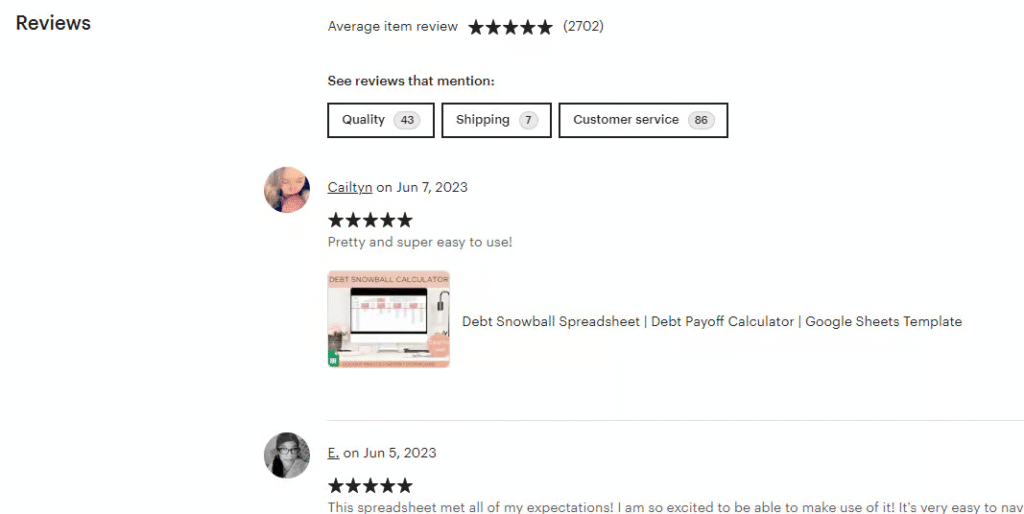
Nearly 3,000 five-star reviews doesn’t happen by accident. It happens by:
- Delivering exactly what you promise (no bait-and-switch)
- Providing instant digital delivery (no waiting, no friction)
- Offering responsive customer support (answering questions quickly)
- Encouraging satisfied customers to leave reviews (strategic follow-up)
Each review builds social proof. Social proof builds trust. Trust drives sales. Sales generate more reviews. It’s a virtuous cycle that compounds over time.
Email Marketing (The Overlooked Etsy Strategy)
This business leverages email marketing for increased customer loyalty and engagement, and increases lead generation by using lead magnets such as free digital products to get email signups through its website.
Here’s what most Etsy sellers miss: Etsy owns the customer relationship, not you. When someone buys from your Etsy shop, you can’t market to them again unless they come back on their own.
Emily solved this by driving traffic to her own website where she captures emails. She offers free budget templates in exchange for email addresses. Those subscribers become repeat customers, affiliate partners, and course buyers.
One customer on Etsy is worth one sale. One email subscriber is worth multiple sales over time.
KEY LEARNING MOMENT: The Digital Product Advantage Formula
Let’s pause and understand why this business model is so powerful:
Low Creation Cost + Zero Marginal Cost + Infinite Scalability = Ridiculous Profit Margins
Compare this to other business models:
Physical products:
- High upfront costs (inventory, manufacturing)
- Storage and fulfillment costs for each unit
- Shipping complications and costs
- Returns and refunds eat into margins
- Capital tied up in inventory
Service businesses:
- Time is directly tied to income (only 24 hours in a day)
- Difficult to scale without hiring
- Constant client management
- Can’t sell the same hour twice
Digital products:
- Create once, sell infinitely
- No inventory or storage costs
- Instant automated delivery
- Minimal customer service (products are self-explanatory)
- 90%+ profit margins after platform fees
Emily creates a spreadsheet in a few hours. That spreadsheet can generate income for years. She’s not trading time for money—she’s creating assets that work 24/7.
That’s the fundamental advantage that makes six-figure income possible without scaling a massive team or working 80-hour weeks.
The Missed Opportunities (Where $100K Could Become $250K+)
Even at six figures annually, there’s substantial room for growth. Let’s examine where Emily’s leaving money on the table.
Website Optimization Issues
According to Nielsen Norman Group, the website should use clearer text colors as some existing text colors appear faint, which is bad for usability and can lead to higher bounce rates or lower dwell time.
This seems minor, but conversion optimization is death by a thousand cuts. If your text is hard to read, people leave. If your CTAs aren’t compelling, people don’t click. If your checkout process is confusing, people abandon carts.
Small improvements compound into significant revenue increases. A 2% conversion rate improvement on 10,000 monthly visitors equals 200 additional sales. At $20 average order value, that’s $4,000 monthly—$48,000 annually—from making text easier to read.
Never underestimate the power of basic usability.
SEO: The Long-Term Traffic Play
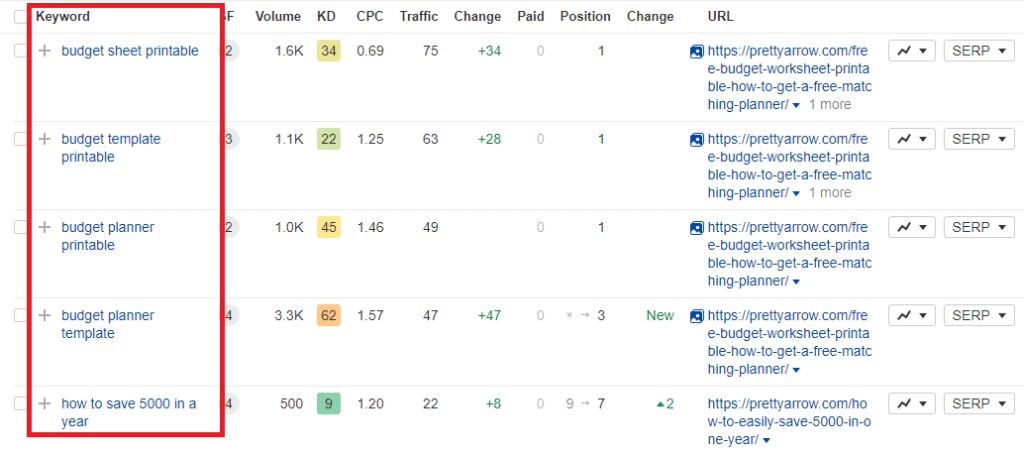
Analysis from Ahrefs shows that the website has a long way to go in terms of organic traffic, backlinks, and domain rating, with SEO practices such as keyword research, high-quality content, and on-page SEO needed to improve organic traffic and sales.
Right now, Emily’s dependent on Etsy’s traffic. That’s fine, but it’s also risky—Etsy controls the algorithm, sets the fees, and could change the rules anytime.
Building organic search traffic through SEO creates an independent traffic source. Blog posts about budgeting tips, debt payoff strategies, and financial planning could:
- Rank for valuable keywords
- Build backlinks and domain authority
- Drive traffic to products
- Establish Emily as an expert
- Create another revenue stream through ads and affiliates
Sites like The Budget Mom and Mint dominate financial planning keywords. There’s room for more voices in this space, especially with a unique product angle.
Paid Advertising: The Scaling Accelerator
Although the product and blog pages are optimized with low competition longtail keywords, they attract little organic traffic, and PPC advertising can help target customers and drive more traffic through compelling copies, CTAs, and optimized landing pages.
The beautiful thing about digital products with high profit margins? You can afford to pay for traffic.
If Emily’s average customer spends $30 and products cost nothing to fulfill, she could potentially spend $15 to acquire a customer and still maintain 50% profit margins after all costs.
Facebook and Pinterest ads would be perfect for this business:
- Visual products that look great in ads
- Clear target audience (women 25-45 interested in personal finance)
- Low friction purchase (instant digital download)
- Proven conversion (thousands of five-star reviews as social proof)
Emily is currently acquiring knowledge and skills in running effective ads for her business, which suggests she recognizes this opportunity. Once she masters paid traffic, revenue could easily double or triple.
Social Media: The Untapped Audience
This business should leverage social media platforms to promote its digital products and drive traffic as it currently has an underutilized presence on Instagram, TikTok, and Pinterest.
Financial planning content performs incredibly well on social media. #FinTok (financial TikTok) is huge. Pinterest drives massive traffic for planners and printables. Instagram is perfect for visually appealing product showcases.
Imagine the content opportunities:
- TikTok: “How I paid off $35K in debt using these spreadsheets”
- Instagram Reels: Quick budgeting tips with product demos
- Pinterest: Pins linking directly to products (Pinterest users actively look to buy)
- YouTube: Tutorials on using the planners effectively
Each platform becomes another traffic source. Content can be repurposed across platforms with minimal additional work.
Creators like Inspired Budget have built massive followings by combining financial education with product sales. The playbook exists—it just needs execution.
Service Expansion: The High-Ticket Opportunities
This business currently focuses more on the sale of digital products, however, it can leverage its varied services for increased competitive advantage and income, with the owner able to delegate the Etsy store to other staff and focus on growing the budget coaching service as well as the online course for entrepreneurs.

Here’s the natural evolution of a successful digital product business:
Phase 1: Sell low-ticket digital products ($5-70)
Phase 2: Sell mid-ticket courses ($197-497)
Phase 3: Sell high-ticket coaching ($1,000-5,000)
Emily’s already proven she can build a six-figure business. That proof is worth money. People will pay for one-on-one coaching to replicate her success. Her course teaching others how to sell digital products could easily generate $50K-100K annually.
The Etsy store becomes the proof of concept. The courses and coaching become the premium offerings.
Ad 🎯 Ready to put these strategies into action?
Theory is great, but execution is what drives growth. That’s where Max Business School™ comes in.
Inside, you’ll find step-by-step digital marketing courses (SEO, ads, email, social, content, and more) — taught by professionals, designed for beginners and business owners alike.
And the best part? It’s 100% free, online, and flexible.
→ Join Max Business School Today — Free
The Origin Story: From Debt to Six Figures
Let me tell you how this actually started, because it’s the kind of story that makes you believe anything’s possible.
Emily McDermott, the owner of PrettyArrow.com, offset her $35,000 student debt through careful budgeting and financial planning, starting the business as a side hustle but eventually quitting her day job to focus on it full-time.
She wasn’t a business guru. She wasn’t a finance expert with an MBA. She was just a young woman drowning in student debt who needed to get her financial life together.
So she created budget spreadsheets for herself. Pretty ones that didn’t make her feel like a failure every time she opened them. They actually helped her pay off $35,000 in debt.
Then she thought: “If these helped me, maybe they’d help other people too.”
She listed a few on Etsy. They sold. She created more. They sold more. She optimized her listings. Sales increased. She reinvested profits into better designs. Sales increased more.
Emily credits the success of her Etsy store to effective keyword research, optimization, and adherence to Etsy’s algorithmic guidelines.
Eventually, the side hustle was generating more income than her day job. So she made the leap. She quit. She went all-in on spreadsheets.
Now she’s not just paying off debt—she’s building wealth and teaching others to do the same.
That’s the power of solving your own problem, then sharing that solution with others who have the same problem.
Your Blueprint for Building a Six-Figure Digital Product Business
Alright, enough inspiration. Let’s get tactical.
Here’s exactly how you can build your own digital product empire.
Phase 1: Niche Selection and Product Ideation (Day 1)
Identify a specific problem you can solve.
The more specific, the better. Not “budgeting” (too broad), but “budget tracking for single moms working multiple jobs” (specific, underserved).
Look for problems you’ve personally solved. Your solution becomes the product.
Research the market demand.
Use Ahrefs or eRank to research Etsy keywords. Look for:
- High search volume (people are actually looking for this)
- Medium competition (not dominated by mega-sellers)
- Price points above $15 (enough margin to be worthwhile)
Study the top-selling products in your niche. What do their listings look like? What’s in their descriptions? What are customers saying in reviews?
Don’t copy—learn and improve.
Create your business plan.
Yes, even for digital products. Outline:
- Your product line (what you’ll create)
- Your ideal customer (who you’re serving)
- Your pricing strategy (what you’ll charge)
- Your growth plan (how you’ll scale)
Choose your business name and secure your domain.
Pick something memorable and relevant. Check availability across:
- Domain names (use DreamHost or similar)
- Etsy shop names
- Social media handles
Consistency across platforms builds brand recognition.
Set up your digital infrastructure.
Create your website using WordPress. Set up your Etsy shop. Create social media accounts on Pinterest, Instagram, and TikTok (where your customers hang out).
Use scheduling tools like Buffer to manage social media efficiently.
Phase 2: Product Creation and Optimization (Day 2)
Create your first product (but make it excellent).
Don’t rush. Your first product sets the tone for your entire business. Make it:
- Genuinely useful (solves a real problem)
- Visually appealing (looks professional and modern)
- Easy to use (includes instructions if needed)
- Print-friendly (if it’s a printable, test it)
Use design tools like Canva or Adobe products. If design isn’t your strength, hire a freelancer on Fiverr or Upwork to create templates you can customize.
Optimize your Etsy listings for search.
Use your keyword research to craft:
- Title: Include your main keyword naturally
- Tags: Use all 13 tags with relevant longtail keywords
- Description: Write for humans first, include keywords naturally
- Photos: Show the product in use, include all pages/features
Study Etsy’s search algorithm guidelines. The platform literally tells you how to rank—most sellers just don’t read it.
Set strategic pricing.
Research competitor pricing. Consider:
- Low-tier products ($5-10): Easy impulse buys, volume plays
- Mid-tier products ($15-25): Your bread and butter
- Premium bundles ($50-100): High-value customers, better margins
Always offer bundles. Psychology of discounts drives higher average order values.
Set up your website storefront.
Don’t rely only on Etsy. Build your own Shopify or WordPress + WooCommerce store. This lets you:
- Capture email addresses
- Avoid platform fees
- Control the customer experience
- Build an owned asset
Integrate your website with Etsy so inventory syncs automatically.
Phase 3: Launch, Scale, and Optimize (Day 3 to ∞)
Launch with momentum.
Tell everyone you know. Post on social media. Join relevant Facebook groups (carefully—don’t spam). Offer a launch discount to drive initial sales.
Your first 10-20 reviews are crucial. Consider offering discounts for honest reviews (within Etsy’s guidelines).
Master the content creation flywheel.
Create content consistently:
- Blog posts about topics your customers care about
- Social media content showcasing your products in use
- Pinterest pins driving traffic to listings
- YouTube tutorials building trust and authority
Each piece of content becomes a 24/7 salesperson working for you.
Implement email marketing from day one.
Offer a free digital product (sample planner, checklist, guide) in exchange for email addresses. Use ConvertKit or Mailchimp to manage your list.
Email your list regularly with:
- New product launches
- Helpful tips and advice
- Exclusive discounts
- Behind-the-scenes content
Your email list will eventually become more valuable than your social media following.
Obsess over reviews and customer service.
Aim for 5-star reviews by delivering exceptional customer service, encouraging feedback, and utilizing customer reviews to refine your services and build a trustworthy reputation.
Respond to messages within hours. Solve problems proactively. Go above and beyond when issues arise. Each five-star review improves your rankings and conversion rate.
Analyze, optimize, repeat.
Continually analyze website metrics using analytics tools to track traffic, bounce rates, and conversion rates.
Track everything:
- Which products sell best
- Which keywords drive the most traffic
- What time of day/week sales peak
- Which social platforms drive buyers
- What email subject lines get opens
Double down on what works. Eliminate or improve what doesn’t.
Expand strategically.
Create a diverse product/service strategy by including custom template services or teaching other entrepreneurs how to run a successful e-commerce store.
Once your core product line is profitable:
- Add complementary products
- Create premium bundles
- Develop courses teaching your system
- Offer coaching or custom services
- License your designs to resellers
Each expansion multiplies your revenue potential.
The Brutal Reality Check (Because Honesty Matters)
Let’s talk about what nobody mentions in the success stories:
Building a six-figure digital product business takes time. Emily didn’t hit $100K in month one. Or month six. Or probably even year one.
The first products might sell slowly. The first listings might get buried in search results. The first social media posts might get zero engagement.
Most people quit after three months when they’ve made $47 total and wonder why this “easy passive income” thing isn’t working.
Here’s what they don’t understand: digital product businesses are compound interest machines.
Month 1-3: Learning the platform, creating products, getting initial sales
Month 4-6: Optimizing based on data, building momentum
Month 7-12: Reviews accumulating, rankings improving, sales increasing
Year 2: Compound effects kicking in, substantial income
Year 3+: True passive income while creating new products
Emily’s business launched in 2020. It’s now generating $100K+ annually because she didn’t quit when growth was slow. She stayed consistent. She optimized continuously. She built assets that compound over time.
Emily credits success to effective keyword research, optimization, and adherence to Etsy’s algorithmic guidelines—not luck, not secret hacks, not shortcuts.
The question isn’t whether this business model works. Clearly it does—thousands of Etsy sellers prove it daily.
The question is whether you’ll commit to the process long enough to see results.
Your Next Move: From Idea to Income
You’ve got the blueprint. You’ve seen the proof. You understand the timeline.
Now comes the moment where most people close this tab, tell themselves “someday,” and never think about it again.
Don’t be most people.
Here’s what I want you to do right now:
- Identify three problems you’ve personally solved that others in your demographic also face
- Search Etsy for products addressing those problems and analyze the competition
- Use eRank or Ahrefs to research keyword demand for those product categories
- Choose one product idea with high demand and manageable competition
- Create a simple mockup of what your product would look like
That’s it. Five actions that take maybe 90 minutes total.
You don’t need to quit your job. You don’t need to invest thousands of dollars. You don’t need perfect conditions.
You just need to start.
Emily McDermott was drowning in $35,000 of student debt when she started. She didn’t have special advantages or insider knowledge. She just had a problem, created a solution, and shared it with others who had the same problem.
Now she’s running a six-figure business selling spreadsheets—the most unglamorous digital product imaginable—and teaching others to build financial freedom.
The opportunity is real. The playbook is proven. The tools are accessible.
The only thing missing is you actually taking action.
So what’s it going to be?
Are you going to bookmark this article and go back to scrolling?
Or are you going to open Canva right now and start designing your first digital product?
Because here’s the truth: six months from now, you’ll wish you had started today.
So why not just… start today?
The spreadsheet empire awaits.