
How a Developer Built a $2K/Month AI SaaS (Without Venture Capital)
Most developer side projects die in GitHub repositories.
They start with excitement—weekends spent coding, visions of passive income dancing in developers’ heads—and end in abandonment when reality hits. No users. No revenue. Just another unfinished project collecting digital dust.
Nick’s story could have followed that same trajectory.
A developer stuck in the same job day after day, watching AI explode into mainstream consciousness while he coded for someone else’s dream. But instead of just dreaming about building something of his own, Nick actually did it.
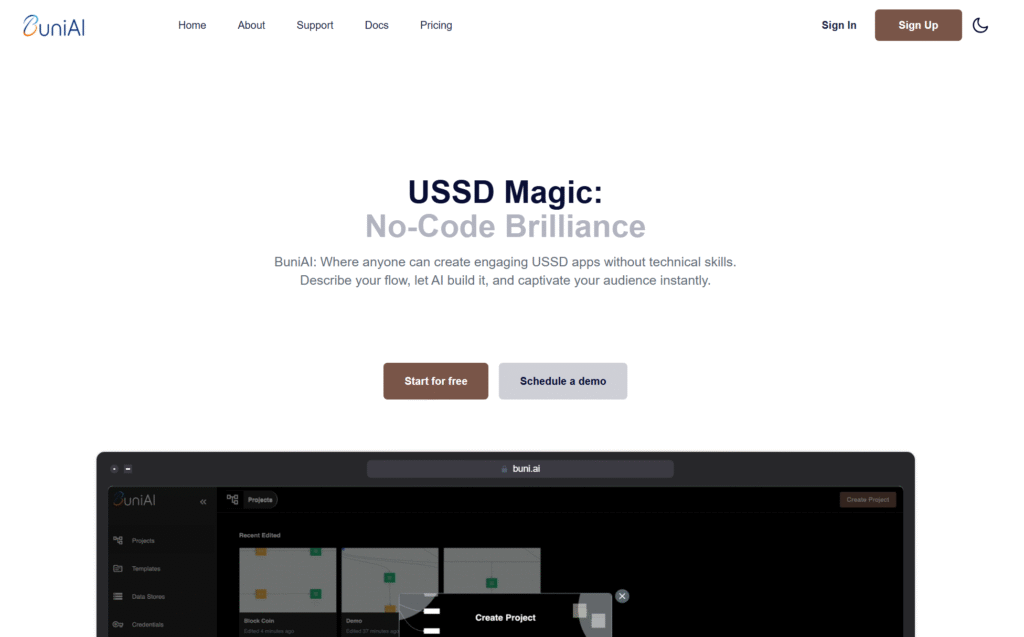
The result? Buni AI—an AI-powered toolkit generating over $2,000 monthly in recurring revenue with a subscription model that scales without proportional effort increases.
No venture capital. No accelerator programs. Just a developer who learned how to build a product people actually want to pay for.
Ad 🎯 After studying 400+ business models, here’s what actually works for beginners…
Most “make money online” advice is garbage. Complex affiliate schemes. Dropshipping nightmares. Social media “influencing.”
We found something better: lead-generation funnels for manufacturers. Simple. Profitable. Fast results.
Our Max Incubator Phase 1 students are proof—they’re going from zero to their first $1,000 in 90 days with this exact model.
→ See the business idea that’s working for beginners this year
Why Most AI Side Projects Fail
The AI boom has created a gold rush mentality among developers.
Everyone sees ChatGPT’s success and thinks “I could build something like that.” They spin up a wrapper around OpenAI’s API, slap a interface on it, and launch to crickets.
Here’s the problem: technical skills alone don’t build businesses.
You can create the most elegant code architecture in the world, but if nobody knows it exists or understands why they should care, it’s worthless. CB Insights research shows that 42% of startups fail because there’s no market need—meaning they built something nobody wanted.
Nick faced this exact challenge.
He knew how to code. He understood AI capabilities. But translating technical skills into a sustainable business required learning an entirely different skillset: marketing, positioning, customer acquisition, and revenue optimization.
What Buni AI Actually Does (And Why People Pay For It)
Buni AI isn’t trying to compete with ChatGPT or Claude.
Instead, it positions itself as a specialized toolkit for specific use cases: entrepreneurs creating ad copy, marketers generating content ideas, developers speeding up code writing, designers prototyping concepts, and copywriters overcoming writer’s block.
The platform offers five core AI tools:
AI text generator for creating written content across formats
AI image generator bringing visual concepts to life without design skills
AI code generator automating routine development tasks
AI chatbot for customer service and conversational interfaces
AI speech-to-text accurately transcribing audio content
Think of it as a Swiss Army knife for AI applications rather than a single-purpose tool. This multi-tool approach creates several advantages: it attracts a broader customer base (each tool appeals to different user types), it increases perceived value (customers get multiple tools for one subscription price), and it creates opportunities for upselling (users who start with one tool often expand usage to others).
The AI tools market is massive and growing. According to Grand View Research, the global AI market was valued at $196.63 billion in 2023 and is projected to grow at a compound annual growth rate of 37.3% through 2030.
But here’s what makes Buni AI sustainable: it’s not trying to capture that entire market. It’s serving a specific segment—individual creators and small teams who need accessible AI tools without enterprise complexity or pricing.
The Revenue Model: Subscriptions That Scale
Buni AI generates revenue through tiered monthly subscriptions designed to accommodate different user needs and budgets.
Let’s break down the pricing structure:
Basic Plan: $10/month – Perfect for individuals just getting started with AI tools. This entry-level tier removes barriers to trying the platform while generating predictable recurring revenue.
Teams Plan: $19/month – Designed for small businesses or teams collaborating on projects. The mid-tier pricing captures customers who’ve outgrown basic features but don’t need enterprise solutions.
PRO Plan: $40/month – Targeted at power users who need all advanced features and maximum support. This tier generates the highest per-customer revenue while serving serious users willing to pay for premium capabilities.
Premium Yearly: $400/year – An annual commitment option that provides upfront cash flow and reduces monthly churn. At $33.33 monthly equivalent, it offers savings that incentivize long-term commitment.
This tiered approach is brilliant for several reasons:
It captures different customer segments. Some users want minimal investment to test the platform. Others need comprehensive features and are willing to pay premium prices. The tiered structure serves both.
It creates clear upgrade paths. Users typically start with basic plans and upgrade as they see value. Each upgrade increases customer lifetime value without requiring new customer acquisition.
It generates predictable recurring revenue. Unlike one-time purchases, subscriptions create cash flow forecasting and compound growth as new subscriptions add to existing ones.
According to Zuora’s subscription economy index, subscription businesses grow revenue 5x faster than traditional product businesses and are more resilient during economic downturns.
What Buni AI Does Exceptionally Well
Nick might not have venture funding or a big team, but he nailed several critical elements:
Diverse Tool Selection Creates Multiple Value Propositions
Instead of betting everything on a single AI feature, Buni offers five distinct tools.
This diversity means different user types find value. A content marketer primarily uses the text generator. A developer mainly needs the code generator. A podcaster relies on speech-to-text transcription.
Each tool serves as a potential entry point, and once users are in the ecosystem, they discover additional tools that expand usage and increase switching costs. The more tools someone relies on, the less likely they’ll cancel their subscription.
Custom Templates Reduce Time to Value
Buni doesn’t just offer raw AI capabilities—it provides pre-built templates for common tasks.
This dramatically reduces the learning curve. Instead of figuring out how to craft effective prompts, users can select templates designed for specific outcomes: social media posts, blog outlines, product descriptions, email campaigns, ad copy variations.
Templates solve a critical problem in AI adoption: the blank page problem. Many people understand AI’s potential but struggle with “what do I even ask it?” Templates eliminate that friction, accelerating users from signup to actual value creation.
Social Proof Through User Testimonials
Buni prominently features user testimonials throughout the site.
This isn’t vanity—it’s conversion optimization. BrightLocal’s research shows that 98% of consumers read online reviews for local businesses, and that pattern extends to SaaS products. People want validation that others have successfully used the product before committing.
Real testimonials from actual users provide that validation, reducing perceived risk and increasing conversion rates from visitors to paying customers.
Transparent Feature Listings Set Clear Expectations
Buni clearly communicates exactly what each subscription tier includes.
No hidden limitations. No surprise feature restrictions discovered after signup. This transparency builds trust and reduces post-purchase dissatisfaction.
When customers know precisely what they’re getting, they make informed decisions. That leads to better customer fit, lower churn rates, and fewer support headaches from customers expecting features not included in their tier.
Where Buni AI Is Leaving Money on the Table
Even with $2,000+ monthly revenue, there are obvious opportunities Nick hasn’t yet captured:
Missing Use Cases Create Friction
When potential customers land on Buni’s website, they see features but not applications.
They know there’s an AI text generator—but they don’t see concrete examples of how a marketing manager uses it to create email campaigns, or how a freelance writer uses it to overcome writer’s block, or how a small business owner uses it to generate social media content.
Use cases bridge the gap between features and benefits. They help potential customers envision themselves successfully using the product. According to Nielsen Norman Group, use case scenarios increase conversion rates by helping users mentally simulate product usage.
Adding a “Use Cases” section showcasing specific applications across different user types (entrepreneurs, marketers, developers, designers, writers) would likely increase conversion rates significantly.
Invisible Calls-to-Action Hurt Conversions
Here’s a website design mistake that costs conversions: CTAs that blend into the background.
When your “Start Free Trial” or “Sign Up Now” buttons don’t visually pop, visitors scroll past without taking action. The conversion funnel breaks at the most critical point—the moment someone decides “yes, I want this” but can’t quickly find how to move forward.
Nick needs bold, contrasting colors for CTAs. Clear, action-oriented copy. Strategic placement at multiple decision points throughout the user journey. These aren’t minor details—they’re revenue optimization levers that can increase conversion rates by 20-30% without changing anything about the actual product.
No Interactive Chat Support Limits Customer Education
Buni sells AI tools but doesn’t use AI for customer support.
An intelligent chatbot could answer technical questions (“What’s the difference between GPT-3.5 and GPT-4 for the text generator?”), help beginners understand capabilities (“I’m a blogger—which tools are most useful for me?”), and guide potential customers toward the right subscription tier.
This would serve two audiences simultaneously: tech-savvy users who want deep dives into capabilities, and beginners who need hand-holding to understand how AI fits their workflows.
Intercom’s research shows that businesses using chatbots see 67% of customer questions resolved without human intervention, reducing support costs while improving response times.
Ad 🎯 Ready to put these strategies into action?
Theory is great, but execution is what drives growth. That’s where Max Business School™ comes in.
Inside, you’ll find step-by-step digital marketing courses (SEO, ads, email, social, content, and more) — taught by professionals, designed for beginners and business owners alike.
And the best part? It’s 100% free, online, and flexible.
→ Join Max Business School Today — Free
Key Lessons From Nick’s Journey
What can you extract from Buni AI’s success that applies to your own product ideas?
Diverse features attract broader audiences. Don’t put all your eggs in one basket. Multiple tools create multiple reasons to subscribe and multiple entry points for different customer types.
Templates and pre-built solutions reduce friction. The faster users achieve value, the more likely they convert and stick around. Remove barriers between signup and success.
Social proof isn’t optional—it’s essential. Testimonials, case studies, and user success stories do the selling when you’re not in the room. Collect and showcase them prominently.
Transparency builds trust and reduces churn. Be clear about what each tier includes. Surprises create unhappy customers who cancel subscriptions.
Demonstrate applications, not just features. People don’t buy features—they buy outcomes. Show them exactly how your product solves their specific problems.
CTAs must be visually dominant. If users have to hunt for the signup button, you’re losing conversions. Make it obvious and impossible to miss.
Use your own technology to enhance customer experience. If you’re selling AI tools, use AI to support customers. The irony of manually answering questions about AI products isn’t lost on potential customers.
The Realistic Path to AI SaaS Success
Nick’s $2,000+ monthly revenue might not sound like Silicon Valley unicorn territory.
But here’s what that number actually represents:
Fully recurring revenue that compounds as new subscriptions add to existing ones. Unlike service businesses where you trade time for money, each new subscriber increases monthly revenue without proportional time investment.
Proof of concept that validates the product-market fit. Nick identified a real need and built something people willingly pay for. That foundation can scale.
Freedom to work on a product he controls. No boss. No corporate politics. Just Nick building something he believes in while generating income that continues growing.
The AI SaaS market is exploding. Gartner predicts that by 2025, 70% of organizations will have deployed AI in some form, creating massive demand for accessible AI tools.
But most developers won’t capitalize on this opportunity.
They’ll get stuck in analysis paralysis, endlessly perfecting their code before launching. Or they’ll build technically impressive products that nobody understands how to use. Or they’ll launch without any marketing strategy and wonder why nobody discovers their creation.
Nick succeeded because he didn’t just code—he learned how to position, market, and sell. Those skills transformed a side project into a real business generating real revenue.
The difference between a GitHub repository and a profitable SaaS product isn’t just technical execution. It’s understanding that code is only one piece of building something people pay for.
What Happens Next?
Buni AI is still early in its journey.
At $2,000+ monthly recurring revenue, Nick has built a foundation that can scale significantly—but only if he applies the growth strategies we’ve discussed.
Here’s the thing about SaaS businesses that most people don’t realize:
The hard part isn’t getting to $2,000 monthly. It’s scaling from $2,000 to $20,000. That jump requires systematizing customer acquisition, optimizing conversion funnels, and expanding the product without losing focus.
But Nick has something most aspiring entrepreneurs never achieve: validation.
Real customers paying real money for something he built. That’s the foundation everything else builds upon.
The Compound Effect of Small Improvements
Let’s do some quick math to show how minor optimizations could transform Buni’s revenue:
If Nick implements use case showcases and conversion rate increases from 2% to 2.6% (a modest 30% improvement), that’s 30% more customers from the same traffic.
If improved CTAs boost conversions another 20%, we’re now looking at 56% more customers than baseline.
If an AI chatbot handles customer education and moves more users toward annual subscriptions (improving cash flow and reducing churn), monthly revenue could easily double within 6-12 months.
That’s not fantasy projecting—it’s what happens when you systematically remove friction from your customer acquisition and conversion funnel.
ProfitWell’s research on SaaS pricing pages shows that most companies leave 30-50% of potential revenue on the table through suboptimal pricing presentation, unclear value propositions, and poor CTA design. Nick’s situation likely follows that pattern.
The Venture Capital Question (And Why Nick Doesn’t Need It)
Some readers might be wondering: “Should Nick raise venture capital to accelerate growth?”
Probably not.
Here’s why: Buni AI is profitable at small scale. Taking VC money means accepting growth-at-all-costs pressure, giving up equity and control, and pivoting from building a sustainable business to chasing the exponential growth VCs require for their fund economics.
For most developers building AI tools, bootstrapping makes more sense. Grow steadily through profitable customer acquisition. Reinvest revenue into product development and marketing. Maintain control and flexibility.
According to Indie Hackers data, bootstrapped SaaS companies that reach profitability have significantly higher survival rates than VC-backed startups chasing unsustainable growth metrics.
Nick has built something valuable. The question isn’t whether to raise money—it’s whether to systematically apply growth tactics that turn $2,000 monthly into $5,000, then $10,000, then $20,000+.
The AI Tools Landscape: Competition and Opportunity
Let’s address the elephant in the room: competition.
The AI tools space is crowded. You’ve got major players like Jasper AI (focused on marketing content), Copy.ai (copywriting automation), Descript (audio/video editing with AI), and dozens of others fighting for market share.
So how does a small player like Buni compete?
By not trying to compete directly.
The major players are targeting enterprise customers and large marketing teams with premium pricing ($50-100+ monthly). Buni sits in the accessible tier for individuals and small teams who need AI capabilities without enterprise complexity.
There’s a massive market segment between “free ChatGPT” and “enterprise AI platform.” That’s Buni’s sweet spot—people who’ve outgrown free tools but don’t need (or can’t afford) premium enterprise solutions.
Gartner’s analysis of the AI market shows significant fragmentation, with room for specialized players serving specific niches rather than trying to be everything to everyone.
Buni doesn’t need to beat Jasper or Copy.ai. It just needs to serve its specific customer segment better than generic alternatives.
Skills Nick Needed Beyond Coding
Here’s what nobody tells developers who want to build SaaS businesses:
Writing code is maybe 20% of what makes a product successful.
The other 80% is everything else—and that’s where most technical founders struggle.
Product positioning: How do you explain what your product does in a way that makes people immediately understand the value? Technical features don’t sell. Outcomes sell.
Customer acquisition: How do you get people to discover your product when you don’t have an advertising budget? SEO, content marketing, strategic partnerships, community building.
Conversion optimization: How do you turn website visitors into paying customers? Landing page design, pricing psychology, social proof placement, friction reduction.
Customer retention: How do you keep subscribers from churning? Onboarding sequences, feature education, continuous value delivery, support quality.
Revenue optimization: How do you maximize lifetime value from each customer? Upgrade paths, annual subscription incentives, usage-based pricing experiments.
Nick had to learn all of this while building the actual product. That’s the real entrepreneurial journey—becoming competent in domains you previously knew nothing about.
Practical Steps to Replicate Nick’s Success
Want to build your own AI SaaS? Here’s the realistic roadmap:
Start with a specific problem, not a general platform. Don’t build “an AI tool.” Build “an AI tool that helps real estate agents write property listings faster” or “an AI tool that helps YouTubers generate video scripts.” Specificity wins in crowded markets.
Launch with one killer feature, not ten mediocre ones. Get one thing working exceptionally well before expanding. Nick launched with multiple tools, but you could start with just one and prove the concept.
Price higher than you’re comfortable with. Most developers underprice their products because they’re comparing to their own willingness to pay rather than target customers’ value perception. Test $20-30 monthly minimums rather than $5-10.
Build in public and document the journey. Share your progress, challenges, and wins on Twitter, LinkedIn, or developer communities. This builds an audience before you even launch and creates organic marketing momentum.
Focus on one distribution channel initially. Don’t spread yourself thin across SEO, paid ads, content marketing, social media, and partnerships. Pick one, master it, then expand. For AI tools, SEO and content marketing typically offer the best ROI.
Talk to customers obsessively. Your assumptions about what people want are probably wrong. Interview users, watch how they actually use your product, and iterate based on real feedback rather than imagined use cases.
Measure everything. Track visitor-to-trial conversion rates, trial-to-paid conversion rates, churn rates, customer acquisition costs, and lifetime value. You can’t optimize what you don’t measure.
The Mental Game of Building Alone
Here’s what’s hardest about Nick’s journey—and it’s not the coding:
It’s the psychological challenge of building something when nobody cares yet.
The first months of launching a product are brutal. You pour hours into development, marketing, and customer support. Revenue trickles in slowly. Self-doubt creeps in. That comfortable job with the steady paycheck starts looking pretty good.
Most people quit right before things start working.
They give up after three months when success often requires six to twelve months of consistent effort. They abandon projects when growth is slow but steady, not realizing that compounding effects need time to materialize.
Y Combinator’s data on startup success shows that persistence is one of the strongest predictors of eventual success. The companies that make it aren’t necessarily the ones with the best initial ideas—they’re the ones that keep iterating and pushing forward when things get hard.
Nick succeeded because he didn’t give up when nobody cared about Buni AI initially. He kept building, kept marketing, kept learning—until eventually, paying customers started appearing.
The Bottom Line: Why This Matters
Nick’s story isn’t about getting rich quick from an AI side project.
It’s about the systematic process of turning technical skills into sustainable income by learning what actually matters in business: understanding customer needs, communicating value clearly, removing barriers to purchase, and delivering genuine results.
$2,000 monthly recurring revenue might not change your life immediately. But it proves the concept. It validates that you’ve built something people want enough to pay for.
And that foundation—real customers paying real money for real value—is something you can build on.
The AI revolution is creating unprecedented opportunities for solo developers and small teams to build profitable products. The technology barriers have never been lower. The market demand has never been higher.
But the same challenges remain: most people won’t commit to learning the non-technical skills required to build a real business. They’ll stay comfortable in their jobs, dreaming about side projects they never launch or abandoning them after a few weeks of minimal traction.
Nick chose differently.
He faced the same fears, the same uncertainties, the same learning curve everyone faces. The difference? He kept going.
If you’re a developer sitting on an idea, wondering if you should take the leap—this is your permission slip. You don’t need venture capital. You don’t need a co-founder. You don’t need an MBA.
You need a specific problem to solve, the willingness to learn what you don’t know, and the persistence to keep building when nobody’s watching.
Nick proved it works. The real question is whether you’ll prove it for yourself.