
How to Earn Five Figures Monthly as a Digital Nomad Blogger

Most people think you need to choose between building a business and traveling the world.
Sharon Gourlay proved that’s nonsense.
Her blog, Digital Nomad Wannabe, pulls in five-figure monthly revenue—sometimes crossing $10,000 in a single month—while she explores the world on her own terms.
No corporate ladder. No office politics. Just a laptop, an internet connection, and a strategy that turns wanderlust into income.
Here’s the beautiful part: she didn’t invent some revolutionary concept. She simply merged two existing niches—travel and online business education—then executed better than almost everyone else in the space.
Let me show you exactly how she did it (and how you could build something similar).
Ad 🎯 After studying 400+ business models, here’s what actually works for beginners…
Most “make money online” advice is garbage. Complex affiliate schemes. Dropshipping nightmares. Social media “influencing.”
We found something better: lead-generation funnels for manufacturers. Simple. Profitable. Fast results.
Our Max Incubator Phase 1 students are proof—they’re going from zero to their first $1,000 in 90 days with this exact model.
→ See the business idea that’s working for beginners this year
The Business Model That Lets You Work From Anywhere
Imagine waking up in Bali one month, Barcelona the next, working a few hours each morning, then spending your afternoons exploring new cities.
That’s not an Instagram fantasy. That’s Sharon’s actual life.
Digital Nomad Wannabe operates at the intersection of two profitable niches: travel blogging and business education. While most travel blogs focus exclusively on destination guides and packing tips, Sharon teaches people how to fund their travel through blogging and online business.
This positioning is brilliant for one simple reason: it solves both sides of the digital nomad equation.
People don’t just want to know where to travel—they want to know how to afford continuous travel without burning through savings or returning to a soul-crushing desk job.
The revenue model combines multiple streams:
Digital products like eBooks and SEO strategy guides bring in consistent income from readers who want condensed, actionable information. Half the total revenue comes from affiliate partnerships with hotel booking platforms—Booking.com, Hotels.com, and Agoda. The remaining affiliate income flows from Amazon, eBay, Airbnb, and travel gear companies.
Throw in sponsored content, advertising, and paid partnerships, and you’ve got a diversified income machine that isn’t dependent on any single revenue source.
If one stream slows down? Four others keep the money flowing.
Why the Dual-Niche Strategy Works (When Everyone Else Picks Just One)
Here’s where most bloggers go wrong.
They pick “travel blogging” as their niche, then wonder why they’re competing against thousands of other sites writing the same generic destination guides.
Or they focus on “make money online” and end up in the overcrowded internet marketing space, fighting for scraps.
Sharon did something smarter: she created a hybrid niche that serves people who want both travel freedom and business income.
Think about it from a reader’s perspective. If you’re dreaming about becoming location-independent, you need two types of information: practical travel advice and legitimate ways to earn money remotely. Most blogs only provide one or the other, forcing readers to piece together knowledge from multiple sources.
Digital Nomad Wannabe delivers both in one place.
This positioning also opens up affiliate opportunities that pure travel blogs miss. Sharon can recommend website hosting, email marketing tools, online course platforms, and productivity software—products with much higher commission rates than typical travel affiliate offers.
A hotel booking might earn a 4% commission. A software subscription could pay 30-50% recurring monthly commissions.
See the difference?
The dual-niche approach isn’t just about standing out—it’s about accessing more lucrative monetization opportunities.
The Facebook Group Strategy That Builds Loyal Audiences
Social media can feel like shouting into the void.
You post content. Maybe a few people like it. Nobody really engages. Your reach keeps declining because the algorithm hates you.
Sharon bypassed all that noise by building a Facebook community around her brand.
Instead of broadcasting to passive followers, she created a space where aspiring digital nomads can connect with each other, share experiences, ask questions, and support one another’s journeys.
This strategy is criminally underutilized by most bloggers, which is baffling because the benefits are massive:
Community creates loyalty. When people feel connected to a group, they stick around. They’re not just following a blog—they’re part of a movement. That emotional investment translates to higher engagement with your content and stronger conversion rates on affiliate recommendations.
Groups provide market research for free. Pay attention to what members ask about, struggle with, and get excited about. Those conversations tell you exactly what content to create and which products to promote.
Word-of-mouth happens organically. Happy community members recommend the group to friends facing similar challenges. Your audience grows without paid advertising or complex marketing funnels.
The group becomes your distribution channel. New blog post? Share it in the group. Launching a product? The community gets first access. You’ve built your own media platform that you fully control—no algorithm can throttle your reach.
Facebook groups require moderation and attention, sure. But the return on that time investment dwarfs almost any other social media strategy.
Sharon understood this early, which explains why Digital Nomad Wannabe maintains such an engaged audience despite the crowded travel blogging landscape.
The Podcast That Sells While It Educates
Text-based content has limitations.
Some people prefer listening while commuting, exercising, or cooking. Others simply connect better with a human voice than written words.
Sharon recognized this and launched a podcast focused on earning income as a blogger and digital entrepreneur.
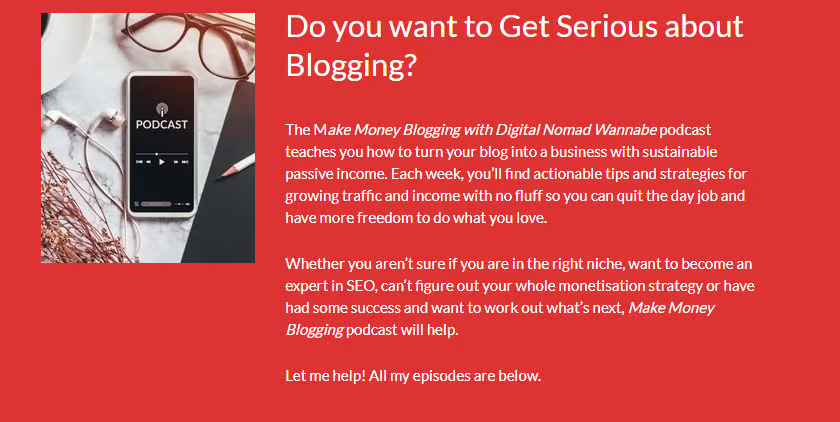
But here’s the clever part: the podcast isn’t just content for content’s sake. It’s a strategic marketing funnel disguised as education and entertainment.
Throughout episodes, Sharon naturally references her eBook guides and courses. Not in a pushy, salesy way—more like “this topic is deep, so if you want the complete framework, I’ve detailed everything in my guide on [specific topic].”
Listeners who love the free podcast content naturally want more depth. They’re already halfway sold because they’ve spent hours listening to Sharon’s voice, learning from her insights, and developing trust in her expertise.
When they finally visit the sales page for her digital products, it’s not a cold pitch—it’s a logical next step in a relationship that’s been building for weeks or months.
The podcast also serves as an SEO and discoverability engine. Episodes distributed through iTunes, Spotify, and other platforms reach audiences who might never stumble across the blog through Google search. It’s another traffic source that diversifies audience acquisition.
Plus, podcasting positions you as an authority faster than almost any other medium. There’s something about hearing someone speak knowledgeably about a topic that accelerates trust-building in ways blog posts can’t quite match.
Sharon’s podcast isn’t massive—it doesn’t need to be. It serves its purpose: deepening relationships with existing audience members and creating additional touchpoints that guide people toward paid offerings.
The Digital Products That Scale Beyond Hourly Work
Here’s the trap most bloggers fall into: they monetize through services that require their time.
Freelance writing. Consulting calls. Coaching sessions.
Those can generate income, sure. But they also chain you to your laptop in ways that defeat the whole purpose of building a location-independent business.
Sharon focuses heavily on digital products—eBooks, guides, courses—because they scale infinitely without consuming more of her time.

Create the product once, sell it thousands of times. The revenue from sale number one hundred requires the same effort as sale number one thousand: zero.
Her product lineup includes practical resources like SEO strategy guides and detailed eBooks on building profitable blogs. These aren’t 20-page fluff pieces—they’re comprehensive resources that genuinely help readers achieve specific outcomes.
This approach works because Sharon’s audience actively seeks condensed, actionable information. They’re busy people trying to build businesses while traveling. They don’t want to spend weeks piecing together scattered blog posts from across the internet.
They’ll happily pay $20-50 for a complete blueprint that saves them dozens of hours of research and trial-and-error.
The beauty of digital products is they also serve as qualification mechanisms. Someone who purchases a $30 guide is significantly more likely to invest in a $300 course later. You’re building a value ladder where each purchase increases trust and willingness to buy higher-ticket offerings.
Start with low-cost products that deliver quick wins, then introduce more comprehensive (and expensive) solutions as customers experience success with your initial offerings.
The Affiliate Strategy Focused on Natural Recommendations
Let’s talk about why Sharon’s affiliate income works when so many others crash and burn.
Most bloggers approach affiliate marketing like this: find high-commission products, write “reviews” based on the sales page, stuff links everywhere, hope someone clicks.
That’s not marketing. That’s spam.
Sharon takes the opposite approach: she recommends products and services she actually uses and believes in, integrating them naturally into content where they genuinely help readers.
The hotel booking affiliates make perfect sense. People reading Digital Nomad Wannabe are actively planning and booking travel. When Sharon shares her experiences in various destinations, linking to booking platforms serves readers while generating commission.
It’s not forced. It’s helpful.
The same logic applies to her other affiliate partnerships. Travel gear from Amazon? She’s used it across dozens of countries. Airbnb? She’s probably booked hundreds of stays. These aren’t theoretical recommendations—they’re based on genuine experience.
This authenticity matters more than most people realize. Readers can sense when you’re shilling products purely for commission versus genuinely recommending something that improved your life or work.
The trust factor determines whether people actually click your affiliate links and complete purchases. Betray that trust with crappy recommendations, and your conversion rates plummet. Honor it with selective, high-quality suggestions, and people actively seek out your recommendations before making purchase decisions.
Sharon’s affiliate revenue split is also instructive: hotel bookings (high purchase intent, natural fit with content) generate about half her affiliate income. This isn’t accidental—she’s identified the affiliate opportunities most aligned with her audience’s immediate needs.
The Growth Opportunity Nobody’s Talking About
Even at five-figure monthly revenue, Digital Nomad Wannabe has obvious room for expansion.
The biggest untapped opportunity? International reach.
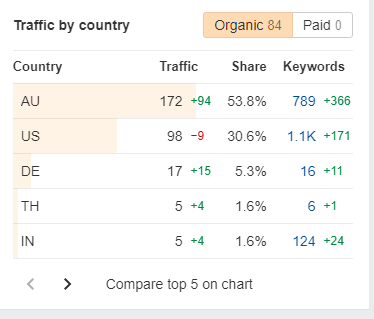
According to traffic analysis data, the blog dominates in Australia—Sharon’s home country. But engagement from other English-speaking markets like the United States, United Kingdom, and Canada lags significantly.
This represents massive potential. The digital nomad lifestyle appeals globally, especially in markets with higher average incomes than Australia. Americans, Brits, and Canadians facing expensive living costs often dream about location independence even more intensely than Australians.
So why the geographic concentration?
Probably a combination of factors: initial audience building happened through Australian networks, content examples skew toward Australian contexts, and SEO optimization may not target keywords popular in other regions.
The fix isn’t complicated: create content addressing specific concerns of American or British audiences, optimize for location-specific keywords, and build backlinks from websites serving those markets.
If Sharon successfully expanded into North American and European audiences with the same engagement levels she enjoys in Australia, monthly revenue could easily double or triple.
We’re talking about potentially crossing $20,000-30,000 monthly by simply reaching audiences who already desperately want the information she provides.
That’s the beautiful thing about online business—geographic expansion doesn’t require opening physical locations, hiring regional teams, or navigating complex international logistics. It’s just strategic content creation and targeted SEO.
Ad 🎯 Ready to put these strategies into action?
Theory is great, but execution is what drives growth. That’s where Max Business School™ comes in.
Inside, you’ll find step-by-step digital marketing courses (SEO, ads, email, social, content, and more) — taught by professionals, designed for beginners and business owners alike.
And the best part? It’s 100% free, online, and flexible.
→ Join Max Business School Today — Free
The Skills That Separate Success From Struggle
Three core competencies determine whether you’ll build a profitable blog or join the cemetery of abandoned domains:
Content creation: Not just writing ability, though that’s crucial. You need to research topics thoroughly, understand what information readers actually need (versus what you think they need), and present everything in engaging, scannable formats. Mediocre content gets ignored no matter how good your SEO or promotion strategy.
Audience building: Growing a loyal readership requires understanding where your target audience hangs out online, what questions they’re asking, and how to position your content as the solution. This includes email list building, community engagement, and strategic networking within your niche.
Monetization strategy: Knowing how to convert traffic into income is its own skillset. When to introduce affiliate links? Which products to promote? How to price digital products? What balance between monetization and free value keeps readers happy? These decisions dramatically impact your revenue.
The good news? All three skills are learnable through practice and study. The bad news? There’s no shortcut. You’ll make mistakes, waste time on ineffective strategies, and occasionally question whether it’s all worth it.
The people who succeed are those who view each failure as data rather than defeat—who test new approaches, analyze what works, and continuously refine their systems.
Industry Context: Why Travel Blogging Still Works
Let’s address the elephant in the room: isn’t travel blogging oversaturated?
Yes and no.
The space has gotten crowded since the glory days of 2010-2015 when anyone with a camera and basic writing skills could build a profitable travel blog. Generic destination guides and “10 Best Things to Do in [City]” posts no longer cut it.
But specialized angles still offer tremendous opportunity. The digital nomad lifestyle market continues growing as remote work becomes normalized across industries. According to recent studies, the number of digital nomads has increased significantly, with millions of professionals now working remotely while traveling.
This creates sustained demand for information about building location-independent income—exactly what Sharon provides.
The key is positioning. “Travel blogger” is too broad. “Digital nomad business educator who happens to travel” is specific enough to stand out. Successful modern travel blogs focus on highly specific angles: solo female travel safety, luxury travel on points and miles, van life logistics, or—like Sharon—funding travel through online business.
Looking at the broader landscape, platforms like Nomad List and Remote Year demonstrate the ongoing appetite for location-independent lifestyle information and services. These companies have raised millions in funding because investors recognize the market’s growth potential.
The industry hasn’t died—it’s matured. Success now requires better strategy, clearer positioning, and higher-quality execution than a decade ago. But for those willing to do the work, the opportunities remain substantial.
Your Action Plan: From Daydream to Digital Nomad
Here’s what taking action actually looks like.
First, validate your niche combination. Sharon’s works because travel + online business education serves a clear audience need. What’s your angle? Maybe it’s remote work for parents, digital nomad fitness, or location-independent creative careers. Find an intersection of topics you know deeply and audiences actively seeking information.
Research existing blogs in your space. What are they doing well? Where are the gaps? Tools like Ahrefs let you analyze competitor traffic, popular content, and keyword opportunities. Don’t copy—learn from what works, then build something better.
Set up your technical foundation. Buy a domain that’s memorable and relevant to your positioning. Get reliable hosting that won’t crash when traffic spikes. Install WordPress and choose a clean, fast-loading theme. None of this is complicated, but it requires time and attention to detail.
Create your content calendar mapping out your first 50 articles. Yes, fifty. This forces you to think strategically about content pillars, keyword targeting, and topic variety. If you can’t brainstorm fifty article ideas in your niche, you’ve either chosen too narrow a focus or don’t know the topic well enough yet.
Launch with 5-10 comprehensive articles already published. Don’t announce your blog with an empty site—give new visitors enough content to evaluate whether you’re worth following. First impressions matter enormously online.
Build your email list from day one. Every visitor who doesn’t subscribe is a lost opportunity. Offer something valuable—a checklist, template, or mini-guide—in exchange for email addresses. Email marketing remains the highest-converting channel for monetization.
Publish consistently for at least 12 months before evaluating success. Traffic growth starts slow, then accelerates as your content library expands and SEO authority builds. The temptation to quit arrives around month four when you’re working hard with minimal results. Push through that wall.
Join affiliate programs aligned with your content once you have traffic. Focus on products you actually use and believe in—authenticity always outperforms shilling for quick commissions.
Consider developing your first digital product around month 10-12, once you’ve identified what questions your audience asks repeatedly. Turn that knowledge into a paid guide or course that provides genuine value.
The Bottom Line: Freedom Has a Formula
Sharon Gourlay’s success with Digital Nomad Wannabe isn’t magic—it’s methodical execution of proven strategies in a well-chosen niche.
She identified an audience (aspiring digital nomads) with a clear problem (how to fund continuous travel), positioned herself as the solution (teaching online business skills specifically for the travel lifestyle), and built multiple revenue streams to monetize that audience.
Five-figure monthly income didn’t arrive overnight. It came from years of consistent content creation, community building, and strategic monetization.
Could you replicate her exact business? Probably not—the digital nomad blogging space has matured since she started. But could you apply her fundamental strategies to a different niche combination? Absolutely.
The formula is proven: Pick a specific audience with clear needs. Create genuinely helpful content consistently. Build community around shared goals. Monetize through authentic recommendations and valuable digital products. Stay patient through the slow growth phase.
Most people quit before the formula has time to work. The five-figure bloggers are simply the ones who refused to quit—who kept publishing, kept learning, kept optimizing even when traffic was embarrassingly low and income was nonexistent.
So the question isn’t whether this model works. The question is whether you’re willing to commit to making it work for you.
The laptop lifestyle isn’t a fantasy. It’s just the result of consistent action applied over sufficient time.
Your move.