
How to Earn $2K Monthly with a Travel Blog in Year One ($24K Yearly)

Someone launched a travel blog one year ago and they’re already making $2,000 a month.
In an industry supposedly saturated beyond hope, where everyone says “travel blogging is dead,” a team of enthusiasts is pulling in two grand monthly with a site that wasn’t even ranking in Google twelve months ago.
This isn’t a story about overnight success or some secret loophole. It’s about understanding traffic, monetization, and content strategy well enough to build something valuable in a competitive space.
Let me break down exactly how they did it.
Ad 🎯 After studying 400+ business models, here’s what actually works for beginners…
Most “make money online” advice is garbage. Complex affiliate schemes. Dropshipping nightmares. Social media “influencing.”
We found something better: lead-generation funnels for manufacturers. Simple. Profitable. Fast results.
Our Max Incubator Phase 1 students are proof—they’re going from zero to their first $1,000 in 90 days with this exact model.
→ See the business idea that’s working for beginners this year
The Revenue Model That Actually Works
Travel blogging has a reputation for being all glamour photos and no money. People think you need millions of followers and brand sponsorships to make it work.
That’s not how most successful travel blogs actually make money.
Display Ads: The Traffic Multiplier
The primary revenue source is display advertising—those ads you see scattered throughout blog posts.
Every time someone visits the site and views ads, the blog makes money. Every click generates additional revenue. At scale, this adds up quickly.
The key is volume. Display ads are a numbers game. More traffic equals more impressions equals more revenue. Which is why the 50,000 monthly visitors this blog is pulling matters so much.
Think about the math: if you’re making $40 per 1,000 page views (a reasonable RPM for travel content), 50,000 visitors viewing 2-3 pages each means 100,000-150,000 page views monthly. That’s $4,000-6,000 from ads alone.
Display ads also work beautifully for travel content because travel posts are inherently long-form. People scroll through destination guides, look at photos, read detailed tips. All that engagement time means more ad views per visitor.
The display advertising landscape has evolved significantly. Quality ad networks like Mediavine and AdThrive pay substantially better than Google AdSense, though they require minimum traffic thresholds (usually 50K sessions for Mediavine). This blog hitting that mark in year one is impressive.
Affiliate Marketing: Recommendations That Pay
The second revenue stream is affiliate marketing—earning commissions when readers book travel through the blog’s links.
Travel is one of the best industries for affiliate marketing because the purchase values are high. Hotels, flights, tours, travel insurance—these aren’t $20 purchases. A single hotel booking can generate $50-100 in commissions.
Smart travel bloggers weave affiliate links naturally into content. Instead of blatant “CLICK HERE TO BOOK,” they write comprehensive destination guides that genuinely help people plan trips. Within that helpful content, they link to booking platforms, tour companies, and travel services they recommend.
When the recommendation is authentic and valuable, people don’t mind clicking affiliate links—they appreciate the curated suggestions that save them research time.
Major travel affiliate programs include Booking.com, Expedia, GetYourGuide, Viator, and various travel insurance companies. Combining multiple programs rather than relying on one maximizes revenue potential across different customer needs.
The beautiful part about affiliate marketing is it scales with traffic without linear cost increase. Whether one person or a thousand people click your links, your effort creating the content was the same.
What This Blog Does Exceptionally Well
Traffic doesn’t just appear. The blog isn’t successful by accident—specific strategic choices drive the results.
50K Monthly Visitors in Year One
Attracting nearly 50,000 unique visitors in the first year is genuinely impressive. Most blogs struggle to reach 10,000 monthly visitors in year one.
This level of traffic indicates they’re doing something right with content strategy and SEO. You don’t get 50K visitors by accident—you get them by targeting the right keywords, creating comprehensive content, and possibly some smart promotion.
For context, many travel bloggers don’t hit this milestone until year 2-3. Reaching it in twelve months suggests either exceptional content quality, smart keyword targeting, or both.
High traffic also means the monetization strategies (ads and affiliates) have room to optimize. Right now at $2K monthly from 50K visitors, there’s definitely opportunity to improve conversion and increase revenue without needing more traffic.
Site Performance That Keeps People Around
Earning an ‘A’ rating on GTmetrix shows commitment to technical excellence.

Site speed matters more than most bloggers realize. Google uses it as a ranking factor. Users abandon slow sites within seconds. Fast loading reduces bounce rates and improves engagement metrics, which signals to search engines that your content is valuable.
For a blog that makes money primarily through ads and affiliate clicks, keeping people on the site longer directly impacts revenue. Fast loading makes that possible.
Most bloggers ignore technical performance until it becomes a problem. This team prioritized it from the start, which has compounding benefits as they grow.
Comprehensive Travel Resources Page
Having a dedicated resources page with detailed information on transportation, accommodation, luggage, and other travel essentials positions the blog as a comprehensive guide rather than just casual content.
This is smart authority building. When you’re the one-stop resource answering all related questions, you become the trusted expert. Trust leads to recommendations, repeat visits, and higher conversion rates on affiliate links.
The resources page also creates natural opportunities for affiliate partnerships. Every tool, service, or product recommended can potentially become an affiliate relationship, turning helpful advice into revenue.
Team of Passionate Travel Enthusiasts
The blog is run by a team genuinely passionate about travel, and it shows in the content quality.
Authenticity resonates. People can tell the difference between someone writing generic content for SEO and someone sharing genuine experience and enthusiasm. The authentic approach builds trust that translates into audience loyalty.
Having multiple contributors also means more diverse perspectives, experiences, and expertise. One person’s knowledge of Southeast Asia complements another’s expertise in European travel, creating more comprehensive coverage.
Passion also sustains long-term commitment. Travel blogging requires consistent effort over years. Teams driven by genuine interest in the topic stick with it through the hard early months when results are minimal.
Where This Blog Needs Immediate Attention
Success in year one doesn’t mean everything’s perfect. There are glaring issues that need fixing before they become bigger problems.
Engagement Dropping Dramatically
Visit duration fell from nearly 39 minutes in August to just 4 minutes by November. That’s catastrophic.
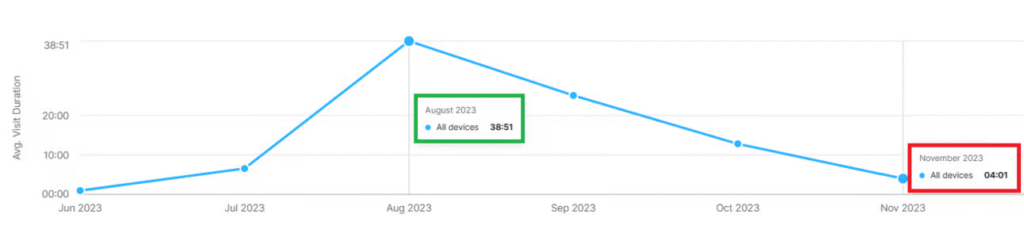
This suggests people aren’t finding what they’re looking for, or content quality declined, or technical issues are causing problems. Regardless of the cause, this needs investigating immediately.
Lower engagement hurts everything: it reduces ad revenue (fewer page views per visitor), decreases affiliate conversions (people leaving before clicking links), and signals to Google that content quality is declining, which tanks rankings.
Potential causes include site speed issues (contradicting the GTmetrix score), content becoming less comprehensive or helpful, changes to layout making navigation worse, or possibly traffic source shifts bringing less engaged visitors.
Whatever the reason, fixing this should be priority one. The difference between 4-minute and 39-minute average visits is potentially thousands of dollars in monthly revenue.
Social Media Presence Basically Nonexistent
For a travel blog, having minimal social media presence is baffling.
Travel is one of the most naturally social topics. People love looking at destination photos, reading travel tips, and planning trips through Instagram, Facebook, and Pinterest inspiration. The blog’s barely active on these platforms despite traffic depending on them.
Instagram for travel is particularly powerful. Beautiful destination photos, short tips in carousel posts, reels showing destinations—all of this content performs exceptionally well and drives traffic back to monetized blog posts.
Pinterest is equally important for travel blogging because people use it specifically for planning. Someone pinning your “10 Best Things to Do in Rome” post might come back to it six months later when actually planning their Italy trip.
Facebook groups for specific destinations or travel styles create community and drive consistent traffic. Creating or participating in relevant groups establishes authority and funnels interested people to your content.
Not leveraging social media means missing massive traffic and revenue potential while competitors who do use it properly capture that audience instead.
Ad 🎯 Ready to put these strategies into action?
Theory is great, but execution is what drives growth. That’s where Max Business School™ comes in.
Inside, you’ll find step-by-step digital marketing courses (SEO, ads, email, social, content, and more) — taught by professionals, designed for beginners and business owners alike.
And the best part? It’s 100% free, online, and flexible.
→ Join Max Business School Today — Free
The Team Behind the Travel Blog
Meet TheGreenVoyage, run by Chiamaka Ihekwoaba, Faiqa Riaz, Harris Mavin, and Taha Khan.
The team focuses on providing practical, accurate travel information that saves people time, money, and frustration. Their content is grounded in actual experience, customer reviews, and thorough research rather than generic advice regurgitated from other sources.
The name “TheGreenVoyage” suggests positioning around sustainable or eco-friendly travel, which is smart niche positioning in an increasingly environmentally-conscious travel market.
What’s notable is they’re affiliate partners with travel service providers, which means they’ve established formal relationships rather than just dropping random affiliate links. This suggests a more strategic, professional approach to monetization than typical beginners take.
The focus on saving travelers time, money, and frustration addresses real pain points. Travel planning is overwhelming—endless options, conflicting reviews, information scattered across dozens of sites. Being the trusted curator who simplifies that chaos is genuinely valuable.
At one year old pulling $2K monthly, they’re ahead of most travel blogs at the same stage. With some adjustments to engagement and social media strategy, there’s clear runway to $5K-10K monthly within another year.
Your Critical Takeaways
Strip away the travel-specific details and here’s what this case study teaches:
High traffic enables multiple monetization streams. Fifty thousand visitors gives you enough volume to make display ads work while simultaneously converting affiliate sales.
Website performance directly impacts revenue. Fast loading keeps people engaged longer, which means more ad views and higher conversion rates.
Comprehensive resources build authority. Being the complete guide rather than just another blog creates competitive advantage.
Authentic passion shows through content. Readers distinguish between genuine expertise and generic content written purely for SEO.
Engagement metrics matter more than traffic volume. Fifty thousand visitors spending 4 minutes generates less revenue than 25,000 visitors spending 39 minutes.
Social media isn’t optional for visual content. Travel blogging without strong Instagram and Pinterest presence is like fishing without bait.
What You’d Actually Need to Start This
Let’s get practical about launching a travel blog that actually makes money.
You need writing skills and travel knowledge, obviously. But more importantly, you need understanding of SEO and content strategy. The best travel stories won’t make money if nobody can find them.
The skill stack includes WordPress website management, basic SEO fundamentals for keyword research and on-page optimization, content creation including writing and photography, social media management across multiple platforms, and email marketing for building a subscriber base.
Photography matters enormously in travel blogging. Your phone camera is probably sufficient to start, but you’ll need to learn composition, editing, and creating scroll-stopping images. Visual content is what stops people mid-scroll on social media.
Starting capital is relatively low compared to product-based businesses. Website hosting and domain ($100-200 annually), potentially a premium WordPress theme ($60-100), basic SEO tools like Ubersuggest or Ahrefs ($100-200 monthly), and maybe some paid promotion to boost initial posts ($200-500).
You can start a travel blog for under $1,000 if you’re scrappy about it. The bigger investment is time—creating comprehensive, high-quality content requires substantial effort.
Here’s the reality check: travel blogging is absolutely competitive, but it’s not impossible. The key is finding your angle. Don’t try to be just another generic travel blog covering the same destinations everyone else writes about.
Maybe you specialize in budget travel, or luxury on points, or traveling with kids, or accessible travel for people with disabilities, or solo female travel, or digital nomad destinations, or sustainable/eco-friendly travel like TheGreenVoyage, or travel for specific professions who have unusual schedules.
Niche positioning matters because it helps you rank for less competitive keywords while building a devoted audience that resonates specifically with your angle.
The Content Strategy That Built This Traffic
Let’s talk about what actually drives 50,000 monthly visitors in year one, because that’s the make-or-break element.
They’re clearly targeting the right keywords. Not impossible-to-rank terms like “best places to visit in Europe” that big sites dominate, but longer, more specific searches people actually use when planning trips.
Terms like “is [specific hotel] worth the price,” “how many days do you need in [destination],” “best area to stay in [city] for families,” “ultimate [destination] itinerary for first timers.” These specific, question-based queries have less competition and convert better because they match specific planning needs.
The content is probably comprehensive rather than superficial. Seven-hundred-word fluff posts don’t rank anymore. Three-thousand-plus-word ultimate guides that answer every question someone might have about a destination do rank. The depth signals to Google that this is authoritative content worth showing people.
They’re likely updating content regularly, which search engines reward. A post published six months ago that gets updated with new information, better photos, and current details often gets a rankings boost.
Internal linking between related posts keeps people clicking around the site (improving engagement metrics) while also helping search engines understand site structure and topic authority.
The comprehensive resources page probably ranks for valuable terms while also serving as a hub linking out to specific posts, passing link equity throughout the site.
The Skills That Matter Most
Technical skills matter, but not as much as you think. You don’t need to be a developer or a Photoshop expert or an SEO wizard.
What you absolutely need:
Consistency. Publishing quality content regularly matters more than occasional viral posts. Two posts weekly for a year beats posting randomly whenever inspiration strikes.
Research ability. Understanding what people are searching for, what questions they have, and what content gaps exist is more valuable than being a naturally gifted writer.
Learning mindset. SEO changes constantly. Social media platforms evolve. Monetization strategies shift. Willingness to learn and adapt determines long-term success more than starting knowledge.
Genuine expertise or curiosity. You don’t need to have visited 100 countries, but you do need genuine interest in travel and willingness to thoroughly research topics you cover.
Patience and persistence. The bloggers who succeed are the ones who keep going through months 1-6 when results are discouraging and quitting seems rational.
The technical stuff—WordPress, basic SEO, social media—can be learned through YouTube tutorials and online courses. The mindset and persistence can’t be taught.
Why Now Is Still a Good Time
Despite everyone claiming blogging is dead and travel blogging especially is oversaturated, TheGreenVoyage proves there’s still opportunity.
Here’s why: most travel content online is mediocre. Generic listicles that regurgitate the same information. Thin content written primarily to rank rather than genuinely help. Outdated posts from 2015 that haven’t been updated.
If you create genuinely comprehensive, helpful content that’s better than what currently ranks, you’ll win. Google’s algorithm gets better every year at identifying and rewarding quality. The bar for what constitutes “good enough” keeps rising, which actually creates opportunity for people willing to exceed it.
AI content threatens to flood the internet with more generic posts, but that actually makes genuinely useful, experience-based content more valuable as a differentiator.
The travel industry continues growing globally. More people travel internationally every year. That means more people searching for travel information, which means more traffic opportunity.
New destinations emerge and become trendy. Albania, Georgia, Colombia—these weren’t major travel blogging topics a decade ago but are now. Being early to cover emerging destinations creates ranking opportunities before competition intensifies.
Your Realistic Path Forward
If you’re thinking about starting a travel blog, here’s your honest roadmap:
Months 1-3: Pick your niche angle. Build your website. Create your first 20-30 comprehensive posts targeting specific, less competitive keywords. Start basic social media presence. Expect minimal traffic and zero revenue.
Months 4-6: Continue publishing 2-3 posts weekly. Start seeing traffic growth as early posts begin ranking. Optimize existing content based on search console data. Begin email list building. Expect $100-300 monthly revenue.
Months 7-12: Accelerate content creation or improve quality of existing posts. Build backlinks through guest posting or outreach. Grow social media following through consistent posting. Apply to ad networks if hitting traffic thresholds. Target $1,000-2,000 monthly revenue.
Year 2: Focus on conversion optimization, improving monetization of existing traffic, and continuing content creation. Build email list aggressively. Explore additional revenue streams like digital products or sponsored content. Target $3,000-5,000 monthly revenue.
This timeline assumes consistent effort—not hobbyist dabbling but treating it like a part-time job with 15-20 hours weekly invested.
Some people move faster. Some slower. TheGreenVoyage clearly moved faster than average by hitting $2K monthly in year one, which suggests either exceptional content strategy, great keyword selection, or possibly team advantages of having multiple contributors creating content.
The Bottom Line
Travel blogging isn’t dead—lazy travel blogging is dead.
If you’re willing to create genuinely helpful content, understand SEO basics, maintain consistency through the difficult early months, and continuously optimize based on data, there’s absolutely still opportunity.
TheGreenVoyage proved you can build a $2,000-monthly travel blog in one year even in a “saturated” niche. They did it through smart traffic building, strong technical performance, and comprehensive content that actually helps readers.
The weaknesses—declining engagement and missing social media presence—are fixable problems that would accelerate growth if addressed.
For anyone considering starting a travel blog: the opportunity exists, but approach it as a business requiring strategic planning and consistent execution, not as a hobby that might accidentally make money.
Do it right, give it time, and the economics work. The question isn’t whether it’s possible—it’s whether you’re willing to put in the work to make it happen.