
How to Build a Motorhome Travel Blog to $7,500 Monthly Revenue (Complete Strategy Breakdown)
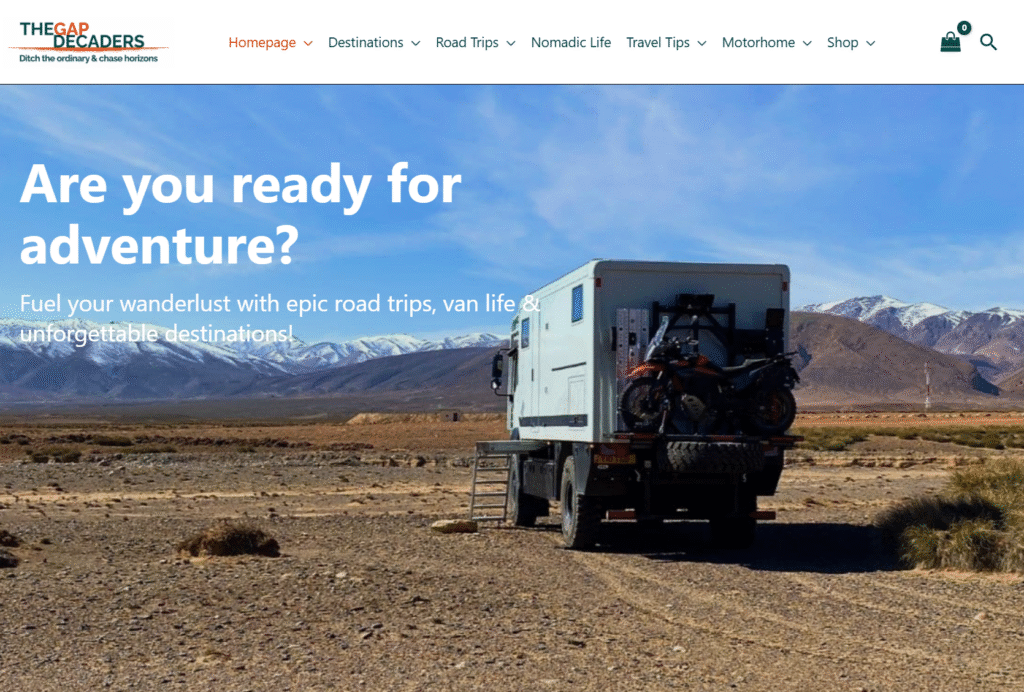
Three years ago, Phil and Izzy were living the dream.
Well, someone’s dream anyway.
They had steady jobs. A house. The whole conventional life package that society assures us leads to happiness and fulfillment.
There was just one problem: they were miserable.
Not in the dramatic, existential crisis way. More like the quiet desperation of Sunday evenings and the creeping realization that this—commutes, cubicles, retirement at 65—might be all there is.
So they did something that most people only daydream about during particularly boring conference calls.
They sold the house. Quit the jobs. Bought a motorhome. And started driving.
But here’s where their story diverges from typical “quit the rat race” fantasies that end in panic and credit card debt: they turned their adventure into a business. A real business generating $7,500 monthly while they explore 28 countries across 30,000+ miles.
Their weapon? A motorhome and road trip travel blog called The Gap Decaders.
No trust fund. No secret inheritance. No cryptic NFT schemes or dropshipping courses. Just strategic content creation, smart monetization, and understanding that the travel blogging gold rush hasn’t ended—it’s just evolved.
Let me show you exactly how they built this.
Ad 🎯 After studying 400+ business models, here’s what actually works for beginners…
Most “make money online” advice is garbage. Complex affiliate schemes. Dropshipping nightmares. Social media “influencing.”
We found something better: lead-generation funnels for manufacturers. Simple. Profitable. Fast results.
Our Max Incubator Phase 1 students are proof—they’re going from zero to their first $1,000 in 90 days with this exact model.
→ See the business idea that’s working for beginners this year
The Revenue Engine: Where $90K Annually Actually Comes From
Let’s talk money first, because that’s why you’re here.
Phil and Izzy generate approximately $7,500 monthly through a diversified income approach that would make any financial advisor nod approvingly. This isn’t putting all eggs in one basket and praying nothing breaks. This is intentional redundancy.
Display Advertising: The Foundation Layer
As visitors scroll through breathtaking photos of Norwegian fjords and detailed guides to wild camping in Scotland, strategically placed display ads generate passive revenue.
This isn’t glamorous income. Nobody writes case studies titled “How I Made Millions Through Banner Ads.” But it’s reliable, predictable, and scales with traffic.
The beauty of display advertising is its complete passivity. Write a blog post once, optimize it for SEO, and it generates ad revenue every single day for years. It’s the closest thing to true passive income that exists in content creation.
Most travel blogs use Mediavine or AdThrive once they hit traffic thresholds. These premium ad networks pay significantly more than generic options like Google AdSense—we’re talking $15-30 RPM (revenue per thousand impressions) versus $3-8 RPM.
With 47,000 monthly visitors, even at conservative $20 RPM, that’s $940 in display ad revenue monthly. Not life-changing money alone, but it’s one piece of a larger machine.
Affiliate Marketing: The Smart Recommendation System
Here’s where travel bloggers separate themselves from digital panhandlers.
Every product recommendation—from motorhome accessories to campground booking platforms to travel insurance—includes affiliate links. When readers click and purchase, Phil and Izzy earn commissions.
The travel affiliate marketing industry is projected to reach $12.21 billion by 2028. This isn’t a niche opportunity. This is a legitimate industry with real money flowing through it.
But here’s the critical distinction: sleazy affiliate marketing pisses people off. Helpful affiliate marketing builds trust.
Phil and Izzy recommend products they actually use. The Coleman camping gear they swear by. The portable solar panels that keep their electronics charged. The specific ferry companies they’ve used to cross from Ireland to France.
Each recommendation comes with context: why they chose it, how it performed, what alternatives they considered. This isn’t “BUY THIS NOW” desperation. It’s “here’s what worked for us” helpfulness.
And readers can tell the difference.
The genius move? Partnering with service providers that offer recurring commissions. Recommend a monthly subscription travel insurance plan, and you get paid every month that person remains a customer. Recommend a motorhome rental platform, and you get commissions on every booking.
This creates compounding affiliate revenue. Every piece of evergreen content becomes a perpetual sales machine.
Digital Products: Monetizing Expertise
Phil and Izzy sell ebooks containing motorhome itineraries and comprehensive travel guides.
This is information arbitrage at its finest. They’ve already done the research, made the mistakes, figured out the best routes. Now they package that knowledge and sell it to people who want the shortcut.
Consider the value proposition from a buyer’s perspective:
You’re planning a three-week motorhome trip through Europe. You could spend 40 hours researching routes, campsites, regulations, and logistics. Or you could spend $29 on a guide that contains all that information plus insider tips from people who’ve actually done it.
For most people, that’s an obvious decision.
Digital products have obscene profit margins. Create once, sell forever. No inventory costs. No shipping logistics. No customer service beyond occasional email questions.
If they sell 50 ebooks monthly at $29 each, that’s $1,450 in pure profit. And these numbers are conservative for a blog with their traffic levels.
YouTube Monetization: The Multi-Platform Advantage
With 3,650 subscribers, 81 videos, and 244,165 total views, their YouTube channel generates additional revenue through ads.
But here’s what most people miss about YouTube as a revenue channel: it’s not just about the ad money (which is modest until you hit massive view counts). It’s about:
- Different audience acquisition: Some people prefer video over reading. You’re capturing different segments of your target market.
- Content multiplication: Film your motorhome tour. That becomes YouTube video content, blog post content, social media clips, and email newsletter material.
- Algorithm advantages: YouTube is the second-largest search engine after Google. Your videos can rank for searches and bring organic traffic for years.
- Audience deepening: Video creates stronger parasocial relationships. Viewers feel like they know you personally.
The YouTube ad revenue might only be $300-500 monthly at their current subscriber count. But the indirect value—traffic, email subscribers, trust-building—is worth multiples of that.
Combined, these four revenue streams create a resilient business that survives algorithm changes, seasonal fluctuations, and market conditions.
The SEO Machine: 47,000 Monthly Visitors Didn’t Happen By Accident
Let’s talk about the real secret weapon: search engine optimization.
Phil and Izzy rank for over 34,000 keywords and attract 47,000 monthly organic visitors. This isn’t luck. This is understanding how search algorithms actually work.

The Keyword Strategy
Every blog post targets specific search queries that their ideal audience types into Google:
- “Best motorhome routes in Scotland”
- “Wild camping rules in Norway”
- “How to travel Europe in a campervan”
- “Motorhome Aires in France”
- “Budget motorhome travel tips”
These aren’t random topics they felt like writing about. These are strategic targets based on keyword research showing search volume and competition levels.
Here’s the methodology:
- Identify what your audience searches for: Use tools like Ahrefs or Semrush to find high-volume, low-competition keywords.
- Create comprehensive content: Don’t write 500-word surface-level posts. Create 2,500-word definitive guides that answer every question.
- Optimize technically: Proper header hierarchy, meta descriptions, image alt text, internal linking, and page speed.
- Build backlinks: Get other travel blogs, tourism sites, and relevant publications to link to your content.
This process sounds simple. It’s not easy.
Most travel bloggers write about whatever they feel like that day. Phil and Izzy write about what people are searching for. That’s the difference between 500 monthly visitors and 47,000.
The Content Quality Advantage
Here’s something most SEO guides skip: quality matters more than ever.
Google’s algorithm updates increasingly prioritize content that demonstrates E-E-A-T: Experience, Expertise, Authoritativeness, and Trustworthiness.
Phil and Izzy have actual experience. They’re not writing about motorhome travel from a Starbucks in Seattle. They’re writing from actual motorhomes in actual countries, with actual photos proving they’ve been there.
This authenticity shows in the content. The recommendations are specific. The tips are practical. The itineraries account for real-world variables like border crossing times and campsite availability.
Google’s algorithms are sophisticated enough to detect the difference between genuine experience and regurgitated information from other blogs.
The Long-Term Compounding Effect
Here’s why SEO is the ultimate leverage play:
That blog post about “Best Campsites in Portugal”? They wrote it two years ago. It ranks on page one of Google. It drives traffic every single day without any additional effort.
Multiply that by 200 blog posts.
Each piece of evergreen content becomes a traffic-generating asset. Write once, benefit forever. This is how blogs scale beyond the hours you can personally work.
The Website Design Philosophy (And Why It Matters)
The Gap Decaders’ website embodies a principle most bloggers ignore: simplicity beats complexity.
Clean layout. Fast loading speeds. Intuitive navigation. High-quality photography that makes you want to quit your job and buy a motorhome immediately.
There are no pop-ups assaulting you 0.3 seconds after arrival. No autoplay videos. No maze-like menus requiring architectural blueprints to navigate.
This isn’t accidental minimalism. This is strategic user experience design.
Here’s what happens when someone lands on a confusing, slow, cluttered website: they leave. Immediately. Before they even read a paragraph.
Average bounce rates for blogs range from 40-60%. Every percentage point improvement means more people staying, reading, clicking affiliate links, and joining email lists.
Phil and Izzy understand that website performance directly impacts revenue. A two-second delay in page load time can decrease conversions by 7%. That’s real money disappearing because someone got impatient waiting for images to load.
The investment in good hosting, optimized images, and clean design pays for itself many times over.
The Genius Move Nobody Notices: The Password-Protected Resource Library
Here’s my favorite part of their strategy.
Most blogs offer typical lead magnets: “Subscribe and get our free PDF checklist.”
Phil and Izzy do something different.
Subscribe to their email list, and you receive a password that unlocks a treasure trove of resources. Guides, checklists, templates, insider tips—valuable information they could easily charge for.
This approach does three brilliant things:
1. Creates perceived exclusivity: Getting a password to access a “members-only” area feels special. It’s psychological positioning that elevates the perceived value.
2. Increases engagement: Subscribers have to actively use the password, visit a specific page, and explore the resources. This engagement deepens the relationship.
3. Differentiates from competitors: In a sea of “download this PDF” sameness, this approach stands out and is memorable.
Most importantly, it transforms passive subscribers into active community members. They’re not just on a list. They’re part of something with access to exclusive information.
This subtle psychological shift dramatically improves email open rates, engagement, and eventual conversion to paid products.
The Massive Opportunities They’re Missing (And Your Competitive Advantage)
Even businesses generating $90K annually have blind spots.
The Social Media Goldmine They’re Ignoring
Phil and Izzy have social media presence. They post occasionally. But they’re not weaponizing it.

Instagram has over 2 billion monthly users, many of whom are actively lusting after the van life and motorhome travel lifestyle.
A strategic Instagram presence with:
- Daily stories showing real van life moments
- Reels optimizing for viral reach
- Strategic hashtag usage for discoverability
- Engagement pods and community building
- Consistent posting schedule
…could easily double their traffic and add $2,000-3,000 monthly in additional affiliate revenue and sponsored content.
Pinterest is even more powerful for their niche. Travel content performs exceptionally well on Pinterest, with pins continuing to drive traffic for months or years after posting.
The average Pinterest user has household income of $100K+. These are people who can afford motorhome rentals, travel gear, and paid guidebooks.
Brand Partnership Revenue They’re Leaving on the Table
Motorhome manufacturers, camping gear brands, travel insurance companies, ferry operators, campground networks—all potential partners for sponsored content.

A sponsored blog post typically pays $500-2,000 depending on traffic and engagement. Sponsored Instagram posts add another $300-1,000. Product seeding relationships provide free gear in exchange for reviews.
With their traffic levels and engaged audience, Phil and Izzy could add $3,000-5,000 monthly through strategic brand partnerships alone.
The key is approaching it strategically—only partnering with brands they actually use and maintaining editorial integrity. Sell out your audience trust, and the whole machine collapses.
Ad 🎯 Ready to put these strategies into action?
Theory is great, but execution is what drives growth. That’s where Max Business School™ comes in.
Inside, you’ll find step-by-step digital marketing courses (SEO, ads, email, social, content, and more) — taught by professionals, designed for beginners and business owners alike.
And the best part? It’s 100% free, online, and flexible.
→ Join Max Business School Today — Free
The Skills You Actually Need to Replicate This
Let’s cut the motivational BS and talk about what this realistically requires.
Photography Skills (Good Enough, Not Professional)
You need to capture images that make people feel something.
Not Ansel Adams-level artistry. Just clear, well-composed photos that tell a story and make someone think “I want to experience that.”
Learn basic composition rules. Understand golden hour lighting. Know how to edit in Lightroom or similar tools.
Your smartphone camera is probably sufficient. The latest iPhones and Android devices take legitimately great photos. The limitation isn’t equipment—it’s skill.
Writing Ability That Keeps People Reading
You need to communicate clearly and engagingly.
This doesn’t mean flowery prose or trying to sound like Hemingway. It means:
- Understanding story structure
- Creating hooks that grab attention
- Organizing information logically
- Writing with personality (not corporate blandness)
- Proofreading so you don’t look illiterate
The average blog post length that ranks on page one of Google is 1,447 words. But length without quality is just wasted space.
Basic WordPress and Technical Competence
You need a functional, professional website that doesn’t break every time you update a plugin.
This requires:
- Understanding hosting and domains
- WordPress installation and configuration
- Theme selection and basic customization
- Plugin management without creating conflicts
- Basic troubleshooting abilities
- Image optimization for web
- Mobile responsiveness verification
You don’t need to become a developer. But you need enough competency to maintain your site without paying someone $100 every time something needs adjusting.
SEO Knowledge (The Real Kind, Not Myths)
You need to understand:
- Keyword research methodology
- Search intent matching
- On-page optimization techniques
- Technical SEO fundamentals
- Link building strategies (white hat only)
- Content structure for featured snippets
This is learnable. It’s not secret knowledge guarded by wizards. It’s documented, teachable, and improvable through practice.
Email Marketing Fundamentals
Building and nurturing an email list separates hobbyists from business owners.
You need:
- Lead magnet creation
- Signup form optimization
- Welcome sequence development
- Regular newsletter content
- Segmentation strategy
- Conversion funnel design
The average email open rate for travel industry is around 20.44%. If you’re below that, your subject lines or sending frequency needs work.
Why This Model Works (And Will Continue To)
The experiential travel market is projected to reach $2.5 trillion by 2030.
People will always want to travel. They’ll always want guidance. They’ll always pay for information that saves them time and improves their experience.
Economic downturns might reduce the number of travelers, but they don’t eliminate the market. Algorithm changes might affect traffic sources, but they don’t kill the fundamental business model.
This is why Phil and Izzy’s approach is resilient:
- Multiple traffic sources (organic, social, YouTube)
- Multiple revenue streams (ads, affiliates, products)
- Evergreen content that remains relevant for years
- Scalable without proportional time investment
They built a real business, not a house of cards dependent on a single platform or trend.
The Bottom Line
Phil and Izzy turned a motorhome into a $90K annual business by understanding that travel blogging isn’t about writing pretty descriptions of sunsets.
It’s about creating valuable information, optimizing for discovery, monetizing strategically, and building systems that scale.
Your version might focus on budget backpacking. Or luxury travel. Or traveling with kids. Or accessible travel for people with disabilities.
The framework works regardless.
Create genuinely helpful content. Optimize for search engines. Build trust through authenticity. Develop multiple income streams. Scale through smart leverage.
The road is open. The opportunity is real.
The question is whether you’re ready to start driving.